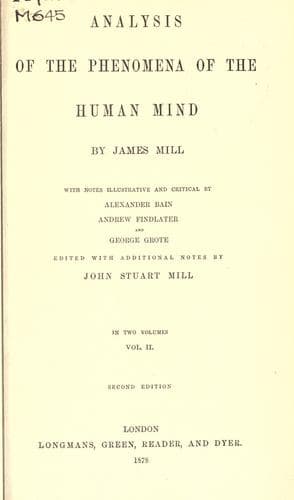
Analysis of the Phenomena of the Human MindMill, James
PhilosophyPhilosophy
Analysis of the Phenomena of the Human Mind
Mill, James
Psychology
But in what manner does the name effect this purpose, of uniting
into one complex class-idea all the objects which agree with one
another in certain definite particulars? We effect this by
associating the name in a peculiarly strong and close manner with
those particulars. It is, of course, associated with the objects
also; and the name seldom or never calls up the ideas of the
class-characteristics unaccompanied by any other qualities of the
objects. All our ideas are of individuals, or of numbers of
individuals, and are clothed with more or fewer of the attributes
which are peculiar to the individuals thought of. Still, a
class-name stands in a very different relation to the definite
resemblances which it is intended to mark, from that in which it
stands to the various accessory circumstances which may form part of
the image it calls up. There are certain attributes common to the
entire class, which the class-name was either deliberately selected
as a mark of, or, at all events, which guide us in the application
of it. These attributes are the real meaning of the class-name--are
what we intend to ascribe to an object when we call it by that name.
With these the association of the name is close and strong: and the
employment of the same name by different {289} persons, provided
they employ it with a precise adherence to the meaning, ensures that
they shall all include these attributes in the complex idea which
they associate with the name. This is not the case with any of the
other qualities of the individual objects, even if they happen to be
common to all the objects, still less if they belong only to some of
them. The class-name calls up, in every mind that hears or uses it,
the idea of one or more individual objects, clothed more or less
copiously with other qualities than those marked by the name; but
these other qualities may, consistently with the purposes for which
the class is formed and the name given, be different with different
persons, and with the same person at different times. What images of
individual horses the word horse shall call up, depends on such
accidents as the person's taste in horses, the particular horses he
may happen to possess, the descriptions he last read, or the casual
peculiarities of the horses he recently saw. In general, therefore,
no very strong or permanent association, and especially no
association common to all who use the language, will be formed
between the word horse and any of the qualities of horses but those
expressly or tacitly recognised as the foundations of the class. The
complex ideas thus formed consisting of an inner nucleus of definite
elements always the same, imbedded in a generally much greater
number of elements indefinitely variable, are our ideas of classes;
the ideas connected with general names; what are called General
Notions: which are neither real objective entities, as the Realists
held, nor mere names, as supposed to be maintained by the
Public-domain text, read in full here on John Shaqi.
Reviews
Reviews
No reviews yet
Be the first to share your thoughts on this work.
Elsewhere in the archive
Join the Discussion
Join the discussion
Sign in to leave a comment or review.
Sign InorCreate an account