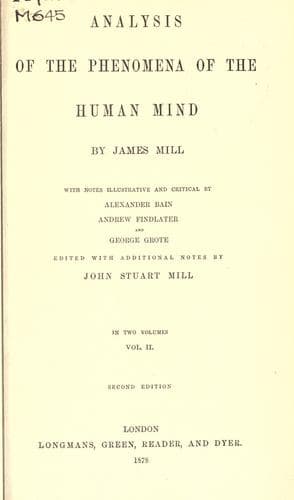
Analysis of the Phenomena of the Human MindMill, James
PhilosophyPhilosophy
Analysis of the Phenomena of the Human Mind
Mill, James
Psychology
The idea of personal IDENTITY, and the idea of TIME, two very
remarkable states of consciousness, will be very carefully examined
hereafter. But for the more ready understanding of what is necessary
to be adduced in expounding those complicated cases of association,
some other phenomena of the mind will first be explained.
What is to be understood by that BELIEF which is said to accompany
MEMORY, will be seen in the next chapter, where all the different
cases of belief will be resolved into their elements.[94]
[Editor's footnote 94: The only difficulty about Memory, when once
the laws of Association are understood, is the difference between it
and Imagination; but this is a difference which will probably long
continue to perplex philosophers. The author finds in Memory,
besides the idea of the fact remembered, two other ideas: "the idea
of my present self, the remembering self, and the idea of my past
self, the remembered or witnessing self:" and a supposed rapid
repetition in thought, of the whole of the impressions which I
received between the time remembered and the {340} time of
remembering. But (apart from the question whether we really do
repeat in thought, however summarily, all this series) explaining
memory by Self seems very like explaining a thing by the thing. For
what notion of Self can we have, apart from Memory? The fact of
remembering, i.e. of having an idea combined with the belief that
the corresponding sensation was actually felt by me, seems to be the
very elementary fact of Self, the origin and foundation of the idea;
presupposed in our having the very complex notion of a Self, which
is here introduced to explain it. As, however, the author admits
that the phenomenon of Belief, and the notions of Time and of
Personal Identity, must be taken into account in order to give a
complete explanation of Memory, any further remarks had better be
deferred until these subjects have been regularly brought under our
consideration.--_Ed._]
{341} CHAPTER XI.
BELIEF.
"Cette recherche peut infiniment contribuer aux progrès de l'art de
raisonner; elle le peut seule développer jusques dans ses premiers
principes. En effet, nous ne découvrirons pas une manière sûre de
conduire constamment nos pensées; si nous ne savons pas comment
elles se sont formées."--_Condillac_, _Traité des Sensations_, p.
460.
IT is not easy to treat of MEMORY, BELIEF, and JUDGMENT, separately.
For, in the rude and unskilful manner in which naming has been
performed, the states of consciousness, marked by those terms, are
not separate and distinct.
Part of that which is named by MEMORY is included under the term
BELIEF; and part of that which is named by JUDGMENT, is also
included under the name BELIEF. BELIEF, therefore, instead of having
a distinct province to itself, encroaches on the provinces both of
MEMORY, and JUDGMENT; from which great confusion has arisen.
Public-domain text, read in full here on John Shaqi.
Reviews
Reviews
No reviews yet
Be the first to share your thoughts on this work.
Elsewhere in the archive
Join the Discussion
Join the discussion
Sign in to leave a comment or review.
Sign InorCreate an account