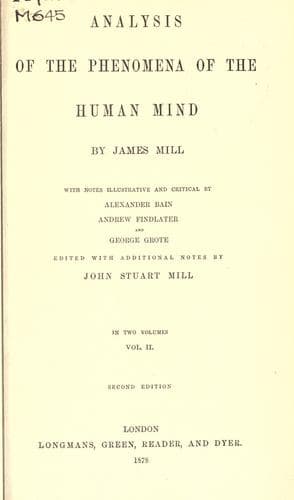
Analysis of the Phenomena of the Human Mind — John Shaqi
Analysis of the Phenomena of the Human MindMill, James
PhilosophyPhilosophy
Analysis of the Phenomena of the Human Mind
Mill, James
Psychology
been thought a sufficient achievement for a whole literary life, may
be said without exaggeration to have been the commencement of
rational thinking on the subject of India: and by that, and his
subsequent {xiv} labours as an administrator of Indian interests
under the East India Company, he effected a great amount of good,
and laid the foundation of much more, to the many millions of
Asiatics for whose bad or good government his country is
responsible. The same great work is full of far-reaching ideas on
the practical interests of the world; and while forming an important
chapter in the history and philosophy of civilization (a subject
which had not then been so scientifically studied as it has been
since) it is one of the most valuable contributions yet made even to
the English history of the period it embraces. If, in addition to
the History and to the present treatise, all the author's minor
writings were collected; the outline treatises on nearly all the
great branches of moral and political science which he drew up for
the Supplement to the Encyclopædia Britannica, and his countless
contributions to many periodical works; although advanced thinkers
have outgrown some of his opinions, and include, on many subjects,
in their speculations, a wider range of considerations than his,
every one would be astonished at the variety of his topics, and the
abundance of the knowledge he exhibited respecting them all. One of
his minor services was, that he was the first to put together in a
compact and systematic form, and in a manner, adapted to learners,
the principles of Political Economy as renovated by the genius of
Ricardo: whose great {xv} work, it may be mentioned by the way,
would probably never have seen the light, if his intimate and
attached friend Mr. Mill had not encouraged and urged him, first to
commit to paper his profound thoughts, and afterwards to send them
forth to the world. Many other cases might be mentioned in which Mr.
Mill's private and personal influence was a means of doing good,
hardly inferior to his public exertions. Though, like all who value
their time for higher purposes, he went little into what is called
society, he helped, encouraged, and not seldom prompted, many of the
men who were most useful in their generation: from his obscure
privacy he was during many years of his life the soul of what is now
called the advanced Liberal party; and such was the effect of his
conversation, and of the tone of his character, on those who were
within reach of its influence, that many, then young, who have since
made themselves honoured in the world by a valuable career, look
back to their intercourse with him as having had a considerable
share in deciding their course through life. The most distinguished
of them all, Mr. Grote, has put on record, in a recent publication,
his sense of these obligations, in terms equally honourable to both.
As a converser, Mr. Mill has had few equals; as an argumentative
Public-domain text, read in full here on John Shaqi.
Reviews
Reviews
No reviews yet
Be the first to share your thoughts on this work.
Join the Discussion
Join the discussion
Sign in to leave a comment or review.
Sign InorCreate an account