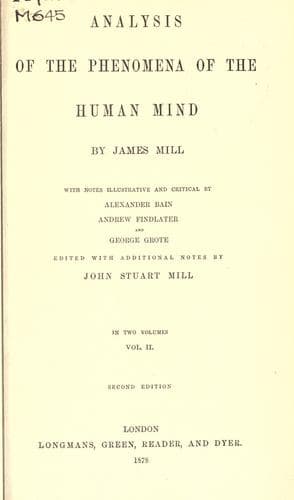
Analysis of the Phenomena of the Human Mind — John Shaqi
Analysis of the Phenomena of the Human MindMill, James
PhilosophyPhilosophy
Analysis of the Phenomena of the Human Mind
Mill, James
Psychology
converser, in modern tunes probably none. All his mental resources
seemed to be at his command at any moment, and were then freely
{xvi} employed in removing difficulties which in his writings for
the public he often did not think it worth while to notice. To a
logical acumen which has always been acknowledged, he united a clear
appreciation of the practical side of things, for which he did not
always receive credit from those who had no personal knowledge of
him, but which made a deep impression on those who were acquainted
with the official correspondence of the East India Company conducted
by him. The moral qualities which shone in his conversation were, if
possible, more valuable to those who had the privilege of sharing
it, than even the intellectual. They were precisely such as young
men of cultivated intellect, with good aspirations but a character
not yet thoroughly formed, are likely to derive most benefit from. A
deeply rooted trust in the general progress of the human race,
joined with a good sense which made him never build unreasonable or
exaggerated hopes on any one event or contingency; an habitual
estimate of men according to their real worth as sources of good to
their fellow-creatures, and an unaffected contempt for the
weaknesses or temptations that divert them from that object, making
those with whom he conversed feel how painful it would be to them to
be counted by him among such backsliders; a sustained earnestness,
in which neither vanity nor personal ambition had any part, and
which spread from him by a sympathetic contagion to those {xvii} who
had sufficient moral preparation to value and seek the opportunity;
this was the mixture of qualities which made his conversation almost
unrivalled in its salutary moral effect. He has been accused of
asperity, and there was asperity in some few of his writings; but no
party spirit, personal rivalry, or wounded _amour-propre_ ever
stirred it up. Even when he had received direct personal offence, he
was the most placable of men. The bitterest and ablest attack ever
publicly made on him was that which was the immediate cause of the
introduction of Mr. Macaulay into public life. He felt it keenly at
the time, but with a quite impersonal feeling, as he would have felt
any thing that he thought unjustly said against any opinion or cause
which was dear to him; and within a very few years afterwards he was
on terms of personal friendship with its author, as Lord Macaulay
himself, in a very creditable passage of the preface to his
collected Essays, has, in feeling terms, commemorated.
Public-domain text, read in full here on John Shaqi.
Reviews
Reviews
No reviews yet
Be the first to share your thoughts on this work.
Join the Discussion
Join the discussion
Sign in to leave a comment or review.
Sign InorCreate an account