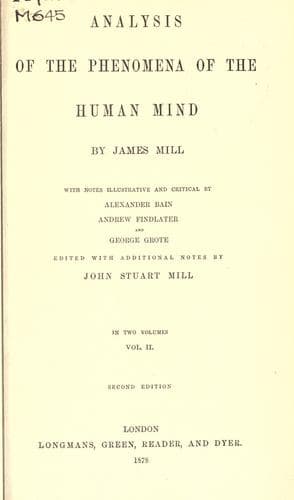
Analysis of the Phenomena of the Human MindMill, James
PhilosophyPhilosophy
Analysis of the Phenomena of the Human Mind
Mill, James
Psychology
Of witnesses in courts of justice it has been remarked, that
eye-witnesses, and ear-witnesses, always tell their story in the
chronological order; in other words, the ideas occur to them in the
order in which the sensations occurred; on the other hand, that
witnesses, who are inventing, rarely adhere to the chronological
order.
3. A far greater number of our sensations are received in the
successive, than in the synchronical order. Of our ideas, also, the
number is infinitely greater that rise in the successive than the
synchronical order.
4. In the successive order of ideas, that which precedes, is
sometimes called the suggesting, that which succeeds, the suggested
idea; not that any power is supposed to reside in the antecedent
over the consequent; suggesting, and suggested, mean only antecedent
and consequent, with the additional idea, that such order is not
casual, but, to a certain degree, permanent.
5. Of the antecedent and consequent feelings, or the suggesting, and
suggested; the antecedent may be either sensations or ideas; the
consequent are always ideas. An idea may be excited either by a
sensation or an idea. The sight of the dog of my friend is a
sensation, and it excites the idea of my friend. The idea of
Professor Dugald Stewart delivering a lecture, recals the idea of
the delight with which I heard him; that, the idea of the studies in
which it engaged me; that, the trains of thought which succeeded;
and each epoch of my mental history, the succeeding one, till the
present moment; in which I am endeavouring to present to others what
appears to me valuable among {82} the innumerable ideas of which
this lengthened train has been composed.
6. As there are degrees in sensation, and degrees in ideas; for one
sensation is more vivid than another sensation, one idea more vivid
than another idea; so there are degrees in association. One
association, we say, is stronger than another: First, when it is
more permanent than another: Secondly, when it is performed with
more certainty: Thirdly, when it is performed with more facility.
It is well known, that some associations are very transient, others
very permanent. The case which we formerly mentioned, that of
repeating words committed to memory, affords an apt illustration. In
some cases, we can perform the repetition, when a few hours, or a
few days have elapsed; but not after a longer period. In others, we
can perform it after the lapse of many years. There are few children
in whose minds some association has not been formed between darkness
and ghosts. In some this association is soon dissolved; in some it
continues for life.[27]
Public-domain text, read in full here on John Shaqi.
Reviews
Reviews
No reviews yet
Be the first to share your thoughts on this work.
Elsewhere in the archive
Join the Discussion
Join the discussion
Sign in to leave a comment or review.
Sign InorCreate an account