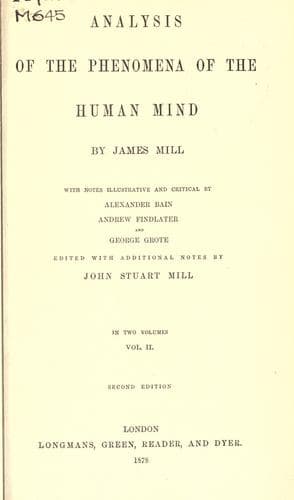
Analysis of the Phenomena of the Human MindMill, James
PhilosophyPhilosophy
Analysis of the Phenomena of the Human Mind
Mill, James
Psychology
[Bain's footnote 27: The difference between transient and permanent
recollections turns entirely upon the strength of the association.
There is not one specific mode of association suited to temporary
recollection and another to permanent; the permanent contains the
temporary, as the greater does the less. The reason why a feebler
association will suffice for temporary purposes, is that a recent
impression still retains something of the hold of a present reality.
The chords struck during the actual presence have not ceased to
vibrate. It is difficult to estimate with precision the influence of
recency; we know it to be very considerable. A thing distinctly
remembered for a few hours will be forgotten, or else held as a mere
fragment, at the end of a month; while anything that persists for
two or three months may be considered as independent of the power of
recency, and may last for years.--_B._]
In some cases the association takes place with less, in some with
greater certainty. Thus, in repeating words, I am not sure that I
shall not commit mistakes, if they are imperfectly got; and I may at
one {83} trial repeat them right, at another wrong: I am sure of
always repeating those correctly, which I have got perfectly. Thus,
in my native language, the association between the name and the
thing is certain; in a language with which I am imperfectly
acquainted, not certain. In expressing myself in my own language,
the idea of the thing suggests the idea of the name with certainty.
In speaking a language with which I am imperfectly acquainted, the
idea of the thing does not with certainty suggest the idea of the
name; at one time it may, at another not.
That ideas are associated in some cases with more, in some with less
facility, is strikingly illustrated by the same instance, of a
language with which we are well, and a language with which we are
imperfectly, acquainted. In speaking our own language, we are not
conscious of any effort; the associations between the words and the
ideas appear spontaneous. In endeavouring to speak a language with
which we are imperfectly acquainted, we are sensible of a painful
effort: the associations between the words and ideas being not
ready, or immediate.
7. The causes of strength in association seem all to be resolvable
into two; the vividness of the associated feelings; and the
frequency of the association.
Public-domain text, read in full here on John Shaqi.
Reviews
Reviews
No reviews yet
Be the first to share your thoughts on this work.
Elsewhere in the archive
Join the Discussion
Join the discussion
Sign in to leave a comment or review.
Sign InorCreate an account