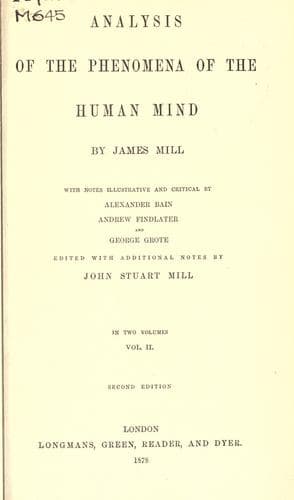
Analysis of the Phenomena of the Human MindMill, James
PhilosophyPhilosophy
Analysis of the Phenomena of the Human Mind
Mill, James
Psychology
In few cases is the strength of association, derived {90} from
repetition, more worthy of attention, than in performing arithmetic.
All men, whose practice is not great, find the addition of a long
column of numbers, tedious, and the accuracy of the operation, by no
means certain. Till a man has had considerable practice, there are
few acts of the mind more toilsome. The reason is, that the names of
the numbers, which correspond to the different steps, do not readily
occur; that is, are not strongly associated with the names which
precede them. Thus, 7 added to 5, make 12; but the antecedent, 7
added to 5, is not strongly associated with the consequent 12, in
the mind of the learner, and he has to wait and search till the name
occurs. Thus, again, 12 and 7 make 19; 19 and 8 make 27, and so on
to any amount; but if the practice of the performer has been small,
the association in each instance is imperfect, and the process
irksome and slow. Practice, however; that is, frequency of
repetition; makes the association between each of these antecedents
and its proper consequent so perfect, that no sooner is the one
conceived than the other is conceived, and an expert arithmetician
can tell the amount of a long column of figures, with a rapidity,
which seems almost miraculous to the man whose faculty of numeration
is of the ordinary standard.
8. Where two or more ideas have been often repeated together, and
the association has become very strong, they sometimes spring up in
such close combination as not to be distinguishable. Some cases of
sensation are analogous. For example; when a wheel, on the seven
parts of which the seven prismatic colours are respectively painted,
is made to revolve rapidly, it appears not of seven colours, but of
one {91} uniform colour, white. By the rapidity of the succession,
the several sensations cease to be distinguishable; they run, as it
were, together, and a new sensation, compounded of all the seven,
but apparently a simple one, is the result. Ideas, also, which have
been so often conjoined, that whenever one exists in the mind, the
others immediately exist along with it, seem to run into one
another, to coalesce, as it were, and out of many to form one idea;
which idea, however in reality complex, appears to be no less
simple, than any one of those of which it is compounded.
The word gold, for example, or the word iron, appears to express as
simple an idea, as the word colour, or the word sound. Yet it is
immediately seen, that the idea of each of those metals is made up
of the separate ideas of several sensations; colour, hardness,
extension, weight. Those ideas, however, present themselves in such
intimate union, that they are constantly spoken of as one, not many.
We say, our idea of iron, our idea of gold; and it is only with an
effort that reflecting men perform the decomposition.
Public-domain text, read in full here on John Shaqi.
Reviews
Reviews
No reviews yet
Be the first to share your thoughts on this work.
Elsewhere in the archive
Join the Discussion
Join the discussion
Sign in to leave a comment or review.
Sign InorCreate an account