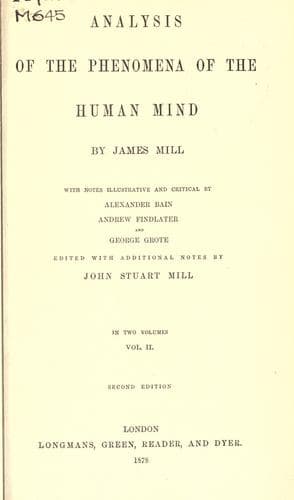
Analysis of the Phenomena of the Human MindMill, James
PhilosophyPhilosophy
Analysis of the Phenomena of the Human Mind
Mill, James
Psychology
The idea expressed by the term weight, appears so perfectly simple,
that he is a good metaphysician, who can trace its composition. Yet
it involves, of course, the idea of resistance, which we have shewn
above to be compounded, and to involve the feeling attendant upon
the contraction of muscles; and the feeling or feelings, denominated
Will; it involves the idea, not of resistance simply, but of
resistance in a particular direction; the idea of direction,
therefore, is included in it, and in that are involved the ideas of
extension, and of place and motion, some of the most complicated
phenomena of the human mind.
{92} The ideas of hardness and extension have been so uniformly
regarded as simple, that the greatest metaphysicians have set them
down as the copies of simple sensations of touch. Hartley and
Darwin, were, I believe, the first who thought of assigning to them
a different origin.
We call a thing hard, because it resists compression, or separation
of parts; that is, because to compress it, or separate it into
parts, what we call muscular force is required. The idea, then, of
muscular action, and of all the feelings which go to it, are
involved in the idea of hardness.
The idea of extension is derived from the muscular feelings in what
we call the motion of parts of our own bodies; as for example, the
hands. I move my hand along a line; I have certain sensations; on
account of these sensations, I call the line long, or extended. The
idea of lines in the direction of length, breadth, and thickness,
constitutes the general idea of extension. In the idea of extension,
there are included three of the most complex of our ideas; motion;
time, which is included in motion; and space, which is included in
direction. We are not yet prepared to explain the simple ideas which
compose the very complex ideas, of motion, space, and time; it is
enough at present to have shewn, that in the idea of extension,
which appears so very simple, a great number of ideas are
nevertheless included; and that this is a case of that combination
of ideas in the higher degrees of association, in which the simple
ideas are so intimately blended, as to have the appearance, not of a
complex, but of a simple idea.
It is to this great law of association, that we trace {93} the
formation of our ideas of what we call external objects; that is,
the ideas of a certain number of sensations, received together so
frequently that they coalesce as it were, and are spoken of under
the idea of unity. Hence, what we call the idea of a tree, the idea
of a stone, the idea of a horse, the idea of a man.
Public-domain text, read in full here on John Shaqi.
Reviews
Reviews
No reviews yet
Be the first to share your thoughts on this work.
Elsewhere in the archive
Join the Discussion
Join the discussion
Sign in to leave a comment or review.
Sign InorCreate an account