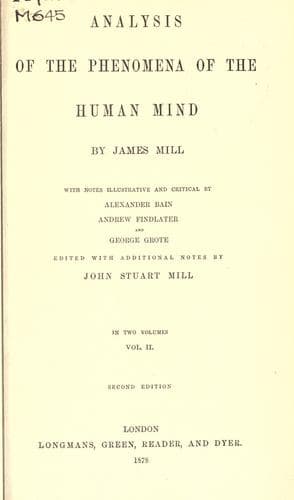
Analysis of the Phenomena of the Human MindMill, James
PhilosophyPhilosophy
Analysis of the Phenomena of the Human Mind
Mill, James
Psychology
eyes, as by the turning of a wheel, the whole is seen as white. The
physiological explanation of this phenomenon may be deduced from
another common experiment. If a lighted torch, or a bar heated to
luminousness, is waved rapidly before the eye, the appearance
produced is that of a ribbon of light; which is universally
understood to prove that the visual sensation persists for a certain
short time after its cause has ceased. Now, if this happens with a
single colour, it will happen with a series of colours: and if the
wheel on which the prismatic colours have been painted, is turned
with the same rapidity with which the torch was waved, each of the
seven sensations of colour will last long enough to be
contemporaneous with all the others, and they will naturally produce
by their combination the same colour as if they had, from the
beginning, been excited simultaneously. If anything similar to this
obtains in our consciousness generally (and that it obtains in many
cases of consciousness there can be no doubt) it will follow that
whenever the organic modifications of our nervous fibres succeed one
another at an interval shorter than the duration of the sensations
or other feelings corresponding to them, those sensations or
feelings will, so to speak, overlap one another, and becoming
simultaneous instead of successive, will blend into a state of
feeling, probably as unlike the elements out of which it is
engendered, as the colour white is unlike the prismatic colours. And
this may be the source of many of those states of internal or mental
feeling which we cannot distinctly refer to a prototype in
experience, our experience only supplying the elements from which,
by this kind of mental chemistry, they are composed. The elementary
feelings may then be said to be latently present, or to be present
but not in consciousness. The truth, however, is that the feelings
themselves are not present, consciously or latently, but that the
nervous modifications which are their usual antecedents have been
present, while the consequents have been frustrated, and another
consequent has been produced instead."
Public-domain text, read in full here on John Shaqi.
Reviews
Reviews
No reviews yet
Be the first to share your thoughts on this work.
Elsewhere in the archive
Join the Discussion
Join the discussion
Sign in to leave a comment or review.
Sign InorCreate an account