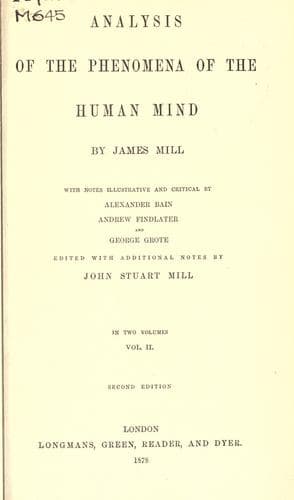
Analysis of the Phenomena of the Human MindMill, James
PhilosophyPhilosophy
Analysis of the Phenomena of the Human Mind
Mill, James
Psychology
Let us try and express the consecutive steps of this case of
reproduction. The thing now present to the mind has certain {122}
peculiarities in common with one or more things formerly present; as
when, in a portrait, the outline and colouring resembles a subject
original. These sensible effects make alive the previous recurrence
of them, or put us in the cerebral and mental attitude formerly
experienced by the corresponding effects of the resembling object.
We are aware, by the liveliness of our impression, that we have gone
in upon an old track; we have the peculiar consciousness called the
consciousness of Identity or Agreement. This is one step, but not
the whole. In order that the complete restoration may be effected,
the features of community must be in such firm contiguous alliance
with the features of difference--the _special_ part of the previous
subject that the one shall reinstate the idea of the other. The
points common to a present portrait and a past original must be so
strongly coherent with the remaining features of the original, that
the one cannot be awakened without the other following. Here, then,
in the very heart of Similarity, is an indispensable bond of
Contiguity; showing that it is not possible for either process to be
accomplished in separation from the other. The mutual coherence of
parts, now described as essential to reproduction, may be too weak
for the purpose, and the recovering stroke of similarity will in
that case fail.
It might, therefore, be supposed that Similarity is, after all, but
a mode of Contiguity, namely, the contiguity or association of the
different features or parts of a complex whole. The inference is too
hasty. Because contiguity is a part of the fact of the restoration
of similars, it is not the entire fact. There is a distinct and
characteristic step preceding the play of this mutual coherence of
the parts of the thing to be recovered. The striking into the former
track of the agreeing part of the new and the old, is a mental
movement by itself, which the other follows, but does not do away
with. The effect above described, as the consciousness of agreement
or identity, the flash of a felt similarity, is real and distinct.
We are conscious of it by itself; there are occasions when we have
it without the other, that is to say, without the full
re-instatement of the former {123} object in its entireness. We
often aware of an identity without being able to say what is the
thing identified; as when a portrait gives us the impression that we
have seen the original, without enabling us to say who the original
is. We have been affected by the stroke of identity or similarity;
but the restoration fails from the feebleness of the contiguous
adherence of the parts of the object identified. There is thus a
genuine effect of the nature of pure similarity, or resemblance, and
a mode of consciousness accompanying that effect; but there is not
Public-domain text, read in full here on John Shaqi.
Reviews
Reviews
No reviews yet
Be the first to share your thoughts on this work.
Elsewhere in the archive
Join the Discussion
Join the discussion
Sign in to leave a comment or review.
Sign InorCreate an account