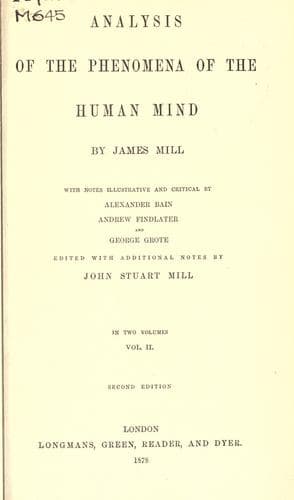
Analysis of the Phenomena of the Human MindMill, James
PhilosophyPhilosophy
Analysis of the Phenomena of the Human Mind
Mill, James
Psychology
the full energy of reproduction without a concurring bond of pure
contiguity. A portrait may fail to give us the consciousness of
having ever seen the original. On the supposition that we have seen
the original, this would be a failure of pure similarity.
Thus in every act of reproducing a past mental experience, there is
a complication, involving both contiguity proper and similarity
proper. When the similarity amounts to identity, as when a new
impression of a thing puts us in the track of the old impressions of
the same thing, the effect is so sure, so obvious, so easily arrived
at, that we do not need to think of it, to make a question of it. It
does not prevent us from regarding the operation of recalling a name
when we see the thing, or recalling a thing when we hear the name,
as pure contiguity. The strength of the coherence may be deficient,
and the restoration may fail on this account; it can never fail on
account of insufficient similarity. No inconvenience will arise from
speaking of this case as if it were Contiguity and nothing else.
The situation of Similarity in Diversity is quite distinct. The
diversity obstructs the operation of similarity; we cannot be sure
that the new shall put us on the track of the old. It is always a
question whether such similarities shall be felt at all; whether we
shall experience the flash, the peculiar consciousness, of agreement
in difference. It is a farther question, whether the internal
coherence of the thing identified is enough to restore it in
completeness. This last step may be allowed to be a case of proper
contiguity; while the flash of identity struck between a present and
a past, never coupled in the {124} mind before, is an effect _sui
generis_, and not resolvable into any mode or incident of
contiguity.
The circumstances of this identifying stroke are so numerous and
far-reaching as to demand a special exemplification. Some of the
broadest distinctions of intellectual character can be grounded on
the distinctive aptitudes of the mind for Contiguity and for
Similarity.
Learning, Acquisition, Memory, Habit, all designate the plastic
adherence of contiguous impressions. The processes of
Classification, Reasoning, Imagination, and the Inventive faculty
generally, depend upon the identifying stroke of likeness in
unlikeness. Some forms of intellectual strength, as a whole, are
best represented by a highly energetic Adhesiveness; distinction as
a learner, a follower of routine, turns upon this power. Other, and
higher, forms of intelligence depend upon far-reaching strokes of
similarity; the identification of likeness shrouded in diversity,
expresses much of the genius of the poet, the philosopher, the man
of practice.
Public-domain text, read in full here on John Shaqi.
Reviews
Reviews
No reviews yet
Be the first to share your thoughts on this work.
Elsewhere in the archive
Join the Discussion
Join the discussion
Sign in to leave a comment or review.
Sign InorCreate an account