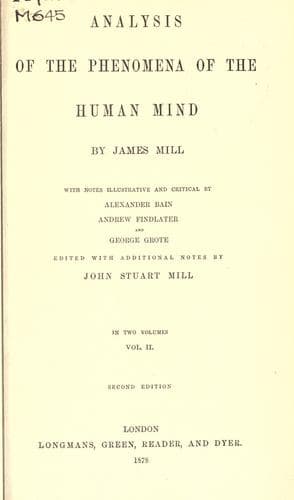
Analysis of the Phenomena of the Human MindMill, James
PhilosophyPhilosophy
Analysis of the Phenomena of the Human Mind
Mill, James
Psychology
The associating principle of Contrast cannot be put forward as a
basis of distinction in intellectual character. There is no such a
thing as a special aptitude for Contrasts. There may be, in certain
minds given to emotion, a fondness for the impressive or emotional
contrasts; but there is no intellectual gift, subsisting apart from
other powers and rising and falling independently, for the mutual
recall of contrasting qualities. Whenever we feel a difference we
make a contrast; the two differing things, are contrasting things,
and are both known in one indivisible act of thought. To be unable
to bring up the contrast of a subject present to the view, is not to
know the subject; we cannot possess intelligently the conception of
"up," and be oblivious to, or incapable of remembering, "down."
Forgetfulness in this department is not the snapping of a link, as
in Contiguity, or the dulness that cannot reach a similitude; it is
the entire blank of conception or knowledge. The north pole of a
magnet cannot be in the view, and the south pole in oblivion.--_B._]
[Editor's footnote 39: The author and Mr. Bain agree in rejecting
Contrast as an independent principle of association. I think they
might {126} have gone further, and denied it even as a derivative
one. All the cases considered as examples of it seem to me to depend
on something else. I greatly doubt if the sight or thought of a
dwarf has intrinsically any tendency to recall the idea of a giant.
Things certainly do remind us of their own absence, because (as
pointed out by Mr. Bain) we are only conscious of their presence by
comparison with their absence; and for a further reason, arising out
of the former, viz. that, in our practical judgments, we are led to
think of the case of their presence and the case of their absence by
one and the same act of thought, having commonly to choose between
the two. But it does not seem to me that things have any special
tendency to remind us of their positive opposites. Black does not
remind us of white more than of red or green. If light reminds us of
darkness, it is because darkness is the mere negation, or absence,
of light. The case of heat and cold is more complex. The sensation
of heat recalls to us the absence of that sensation: if the
sensation amounts to pain, it calls up the idea of relief from it;
that is, of its absence, associated by contiguity with the pleasant
feeling which accompanies the change. But cold is not the mere
absence of heat; it is itself a positive sensation. If heat suggests
to us the idea of the sensation of cold, it is not because of the
contrast, but because the close connection which exists between the
outward conditions of both, and the consequent identity of the means
we employ for regulating them, cause the thought of cold and that of
heat to be frequently presented to us in contiguity.--_Ed._]
{127} CHAPTER IV.
NAMING.
Public-domain text, read in full here on John Shaqi.
Reviews
Reviews
No reviews yet
Be the first to share your thoughts on this work.
Elsewhere in the archive
Join the Discussion
Join the discussion
Sign in to leave a comment or review.
Sign InorCreate an account