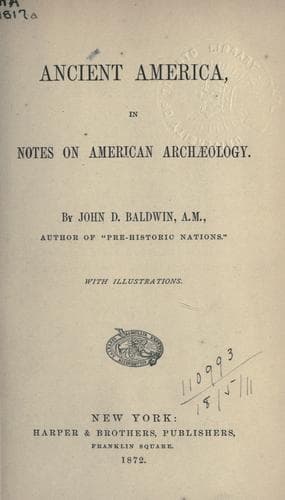
Ancient America, in Notes on American ArchaeologyBaldwin, John D. (John Denison)
History
Ancient America, in Notes on American Archaeology
Baldwin, John D. (John Denison)
America -- Antiquities; America -- Discovery and exploration -- Pre-Columbian; Indians -- Antiquities
This assumes that the worship of Kukulcan was never heard of by the
Mayas until the Aztecs arrived in Mexico, an assumption for which there
is no warrant, and which proceeds in utter disregard of facts. It was
the Aztecs who had never heard of Kukulcan, or, at least, had not
adopted his worship, previous to this time. The Aztecs, when they
settled in Anahuac, did not impart new ideas, religion, or culture to
any body; on the contrary, they received much from the civilization of
their new neighbors, which was more advanced than their own. It is very
certain that neither the Mayas nor the Quichés borrowed any thing from
them.
We need not go back so far as the ninth century to find the time when
the Aztecs adopted, or at least organized in Mexico, the worship of
Kukulcan, whose name they transformed into Quetzalcohuatl. His worship
did not begin with them; they did not introduce it; they found it in the
country as a very ancient worship, and adopted their form of it from the
people who yielded to their sway.
If M. de Charencey will inquire with a little more care, he will
discover that Kukulcan was one of the very oldest personages in Central
American mythology, as _Con_ was one of the oldest in that of Peru.
Kukulcan, sometimes as Zamnà, was associated with almost every thing in
civilization. He introduced the beginnings of civilized life, invented
the art of writing, and was to the Central Americans not wholly unlike
what Thoth was to the Egyptians, and Tautus, or Taut, to the Phœnicians.
If the bas-relief of the cross at Palenque were half as old as his
worship in Central America, it would be far more ancient than any one
has supposed.
GENERAL INDEX.
[The figures in this Index refer to pages.]
Adobe used in Northern Mexico, 82;
in Peru for later constructions, 243;
used by Mound-Builders, 27.
Ancient history of Mexico and Central America in the old books and
traditions, 197-200;
Aztecs preceded by Toltecs, and Toltecs by Colhuas, 198;
Colhuas the original civilizers, 198-9;
they may have come from South America, 198, 200;
Chichimecs the original barbarians, 198;
the Colhuas first settled in Tabasco, 199;
Mayas, Quichés, Tzendals, etc., originally Colhuas, 200, 205;
Colhuan kingdom of Xibalba, 199;
Colhuas, Toltecs, and Aztecs branches of the same people, 206;
such a history implied by the political condition in which the
country was found, 206;
theories of this old civilization considered, 165-183;
it was original in America, 184-6.
Antiquity of man and civilization, 181-2, 273-5.
Public-domain text, read in full here on John Shaqi.
Reviews
Reviews
No reviews yet
Be the first to share your thoughts on this work.
Elsewhere in the archive
Join the Discussion
Join the discussion
Sign in to leave a comment or review.
Sign InorCreate an account