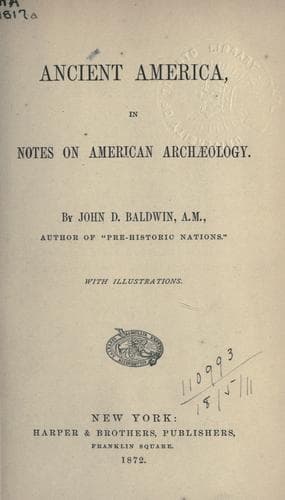
Ancient America, in Notes on American ArchaeologyBaldwin, John D. (John Denison)
History
Ancient America, in Notes on American Archaeology
Baldwin, John D. (John Denison)
America -- Antiquities; America -- Discovery and exploration -- Pre-Columbian; Indians -- Antiquities
A very large proportion of the old structures in Ohio and farther south
called “mounds,” namely, those which are low in proportion to their
horizontal extent, are terraced foundations for buildings, and if they
were situated in Yucatan, Guatemala, and Southern Mexico, they would
never be mistaken for any thing else. The high mounds also in the two
regions are remarkably alike. In both cases they are pyramidal in shape,
and have level summits of considerable extent, which were reached by
means of stairways on the outside. The great mound at Chichen-Itza is 75
feet high, and has on its summit a ruined stone edifice; that at Uxmal
is 60 feet high, and has a similar ruin on its summit; that at Mayapan
is 60 feet high; the edifice placed on its summit has disappeared. The
great mound at Miamisburg, Ohio, is 68 feet high; and that at Grave
Creek, West Virginia, is 75 feet high. Both had level summits, and
stairways on the outside, but no trace of any structure remains on them.
All these mounds were constructed for religious uses, and they are, in
their way, as much alike as any five Gothic churches.
Could these works of the Mound-Builders be restored to the condition in
which they were when the country was filled with their busy communities,
we should doubtless see great edifices, similar in style to those in
Yucatan, standing on the upper terraces of all the low and extended
“mounds,” and smaller structures on the high mounds, such as those above
named. There would seem to be an extension of ancient Mexico and Central
America through Texas into the Mississippi and Ohio valleys; and so, if
there were no massive stone-work in the old ruins of those countries, it
might seem that the Mound-Builders’ works were anciently extended into
them by way of Texas.
The fact that the settlements and works of the Mound-Builders extended
through Texas and across the Rio Grande indicates very plainly their
connection with the people of Mexico, and goes far to explain their
origin. We have other evidence of intercourse between the two peoples;
for the obsidian dug from the mounds, and perhaps the porphyry also, can
be explained only by supposing commercial relations between them.
We can not suppose the Mound-Builders to have come from any other part
of North America, for nowhere else north of the Isthmus was there any
other people capable of producing such works as they left in the places
where they dwelt. Beyond the relics of the Mound-Builders themselves, no
traces of the former existence of such a people have been discovered in
any part of North America save Mexico, and Central America, and
districts immediately connected with them. At the same time, it is not
unreasonable to suppose the civilized people of these regions extended
their settlements through Texas, and also migrated across the Gulf into
the Mississippi Valley. In fact, the connection of settlements by way of
Texas appears to have been unbroken from Ohio to Mexico.
Public-domain text, read in full here on John Shaqi.
Reviews
Reviews
No reviews yet
Be the first to share your thoughts on this work.
Join the Discussion
Join the discussion
Sign in to leave a comment or review.
Sign InorCreate an account