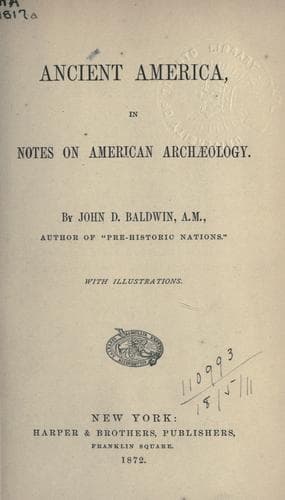
Ancient America, in Notes on American ArchaeologyBaldwin, John D. (John Denison)
History
Ancient America, in Notes on American Archaeology
Baldwin, John D. (John Denison)
America -- Antiquities; America -- Discovery and exploration -- Pre-Columbian; Indians -- Antiquities
This colonizing extension of the old Mexican race must have taken place
at a remote period in the past; for what has been said of the antiquity
of the Mound-Builders shows that a very long period, far more than two
thousand years, it may be, must have elapsed since they left the Valley
of the Ohio. Perhaps they found the country mostly unoccupied, and saw
there but little of any other people until an irruption of warlike
barbarians came upon them from the Northwest.
In speculating on the causes of their withdrawal after centuries of
occupation, absolute certainty is impossible, and we have no means of
going much beyond mere conjecture. We may suppose as most probable that
an influx of barbarians destroyed their border settlements, interrupted
their mining operations, and caused them to retire gradually toward the
Gulf. Fragments of their communities may have become incorporated with
the barbarous tribes. This conjecture has been used to explain certain
exceptional peculiarities noticed in some of the wild Indian tribes. For
instance, it has been suggested that the Mandan Indians were a separated
and lost fragment of the mound-building people, they being noticeably
unlike other Indians in many respects, lighter in color, and peculiar in
manners and customs. What is conjectured may be true, but we have no
means of proving its truth. That the Mandans were like what a lost
community of Mound-Builders might have become by degeneration through
mixture and association with barbarians may be supposed, but the actual
history of that remarkable tribe might give its peculiarities a very
different explanation. The Mandans were supposed to be a branch of the
Dacotahs. They may have been, like the Navajos, a changed community of
Pueblos, but any attempt to explain them by means of conjecture is
useless.
The supposition that the Toltecs and the Mound-Builders were the same
people seems to me not improbable. The reasons for it will be stated
when we come to a discussion of the antiquities, books, and traditions
of Central America. I will only say here that, according to dates given
in the Central American books, the Toltecs came from “Huehue-Tlapalan,”
a distant country in the northeast, long previous to the Christian era.
They played a great part and had a long career in Mexico previous to the
rise of their successors in power, the Aztecs, who were overthrown by
the Spaniards.
IV.
MEXICO AND CENTRAL AMERICA.
Public-domain text, read in full here on John Shaqi.
Reviews
Reviews
No reviews yet
Be the first to share your thoughts on this work.
Join the Discussion
Join the discussion
Sign in to leave a comment or review.
Sign InorCreate an account