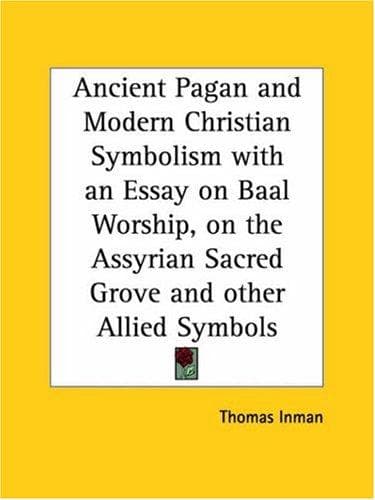
Ancient Pagan and Modern Christian Symbolism: With an Essay on Baal Worship, on the Assyrian Sacred "Grove," and Other Allied Symbols — John Shaqi
Ancient Pagan and Modern Christian Symbolism: With an Essay on Baal Worship, on the Assyrian Sacred "Grove," and Other Allied SymbolsInman, Thomas
Religion
Ancient Pagan and Modern Christian Symbolism: With an Essay on Baal Worship, on the Assyrian Sacred "Grove," and Other Allied Symbols
Inman, Thomas
Christian art and symbolism; Symbolism
I will only add, that what I refer to has long been known to almost
every scholar except English ones. Of these a few are learned; but for
a long period they have systematically refrained from speaking plainly,
and have written in such a manner as to be guilty not only of suppressio
veri but of suggestio falsi.
After reading thus far, I can imagine many a person saying with
astonishment, "Are these things so?" and following up his thoughts by
wondering what style of persons they were, or are, who could introduce
into religion such matters as those of which we have treated.
In reply, I can only say that I have nothing extenuated, and set
down nought in malice. But the first clause of the assertion requires
modification, for in this volume there are many things omitted which I
have referred to at length in my larger work. In that I have shown, not
only that religious fornication existed in ancient Babylon, but that
there is reason to believe that it existed also in Palestine. The word
[--Hebrew--] Kadesh, which signifies "pure, bright, young, to be holy,
or to be consecrated," is also the root from which are formed the words
Kadeshah and Kadeshim, which are used in the Hebrew writings, and are
translated in our authorised version "whore" and "sodomite." See Bent,
xxiii. 17.
Athanasius tells us something of this as regards the Phoenicians, for
he says, (Oratio Contr. Gent., part i., p. 24.) "Formerly, it is
certain that Phoenician women prostituted themselves before their idols,
offering their bodies to their gods in the place of first fruits, being
persuaded that they pleased the goddess by that means, and made her
propitious to them."
Strabo mentions a similar occurrence at Comana, in Pontus, book xiii.,
c. iii. p. 86--and notices that an enormous number of women were
consecrated to the use of worshippers in the temple of Venus at Corinth.
Such women exist in India, and the priests of certain temples do
everything in their power to select the loveliest of the sex, and to
educate them so highly as to be attractive.
The customs which existed in other places seem to have been known in
Jerusalem, as we find in 1 Kings xiv. 24., XV. 12, that Kadeshim
were common in Judea, and in 2 Kings xxiii. 7, we discover that these
"consecrated ones" were located "by the temple," and were associated
with women whose business was "to make hangings for the grove." What
these tissues were and what use was made of them will be seen in Ezekiel
xvi. 16.
Even David, when dancing before the ark, shamelessly exposed himself.
Solomon erected two pillars in the porch of his temple, and called
them Jachin and Boaz, and added pomegranate ornaments. We have seen how
Abraham and Jacob ordered their inferiors to swear by putting the hand
upon "the thigh"; and we have read of the atrocities which occurred in
Jerusalem in the time of Ezekiel. Yet the Jews are still spoken of as
God's chosen people, and the Psalmist as a man after God's own heart.
Public-domain text, read in full here on John Shaqi.
Reviews
Reviews
No reviews yet
Be the first to share your thoughts on this work.
Join the Discussion
Join the discussion
Sign in to leave a comment or review.
Sign InorCreate an account