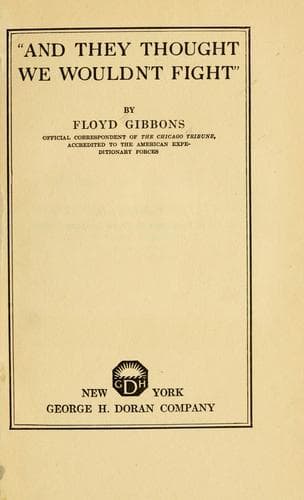
"And they thought we wouldn't fight"Gibbons, Floyd Phillips
History
"And they thought we wouldn't fight"
Gibbons, Floyd Phillips
World War, 1914-1918 -- Campaigns -- Western Front; World War, 1914-1918 -- Personal narratives
A train of ammunition trucks, timed to arrive at the moment when the
road was unoccupied, put in appearance as the end of the infantry column
passed, and the captain in charge urged the men on to speedy unloading
and fumed over delays by reason of darkness. The men received big shells
in their arms and carried them to the roadside dumps where they were
piled in readiness for the guns. The road was in an exposed position and
this active battery was liable to draw enemy fire at any time, so the
ammunition train captain was anxious to get his charges away in a hurry.
His fears were not without foundation, because in the midst of the
unloading, one German missile arrived in a nearby field and sprayed the
roadway with steel just as every one flattened out on the ground. Five
ammunition hustlers arose with minor cuts and one driver was swearing at
the shell fragment which had gone through the radiator of his truck and
liberated the water contents. The unloading was completed with all
speed, and the ammunition train moved off, towing a disabled truck. With
some of the gunners who had helped in unloading, I crawled into the
chalk dugout to share sleeping quarters in the straw.
"What paper do you represent?" one man asked me as he sat in the straw,
unwrapping his puttees. I told him.
"Do you want to know the most popular publication around this place?" he
asked, and I replied affirmatively.
"It's called the _Daily Woollen Undershirt_," he said. "Haven't you seen
everybody sitting along the roadside reading theirs and trying to keep
up with things? Believe me, it's some reading-matter, too."
"Don't let him kid you," said the section chief, "I haven't had to read
mine yet. The doctor fixed up the baths in town and yesterday he passed
around those flea charms. Have you seen them?"
For our joint inspection there was passed the string necklace with two
linen tabs soaked in aromatic oil of cedar, while the section chief
gave an impromptu lecture on personal sanitation. It was concluded by a
peremptory order from without for extinction of all lights. The candle
stuck on the helmet top was snuffed and we lay down in darkness with the
guns booming away on either side.
* * * * *
Our positions were located in a country almost as new to war as were the
fields of Flanders in the fall of '14. A little over a month before it
had all been peaceful farming land, far behind the belligerent lines.
Upon our arrival, its sprouting fields of late wheat and oats were
untended and bearing their first harvest of shell craters.
The abandoned villages now occupied by troops told once more the mute
tales of the homeless. The villagers, old men, old women and children,
had fled, driving before them their cows and farm animals even as they
themselves had been driven back by the train of German shells. In their
deserted cottages remained the fresh traces of their departure and the
ruthless rupturing of home ties, generations old.
Public-domain text, read in full here on John Shaqi.
Reviews
Reviews
No reviews yet
Be the first to share your thoughts on this work.
Elsewhere in the archive
Join the Discussion
Join the discussion
Sign in to leave a comment or review.
Sign InorCreate an account