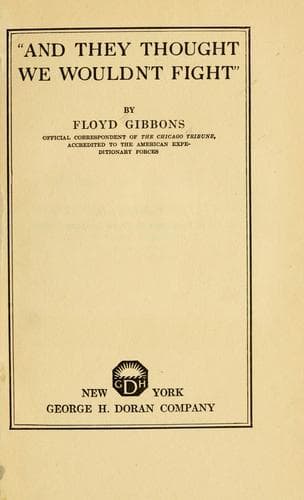
"And they thought we wouldn't fight"Gibbons, Floyd Phillips
History
"And they thought we wouldn't fight"
Gibbons, Floyd Phillips
World War, 1914-1918 -- Campaigns -- Western Front; World War, 1914-1918 -- Personal narratives
Between Meaux and Chateau-Thierry, where the road wound along the Marne,
our men encountered long trains of French refugees, weary mothers
carrying hungry babies at the breast, farm wagons loaded with household
belongings, usually surmounted by feather mattresses on which rode
grey-haired grandfathers and grandmothers. This pitiful procession was
moving toward the rear driving before it flocks of geese and herds of
cattle. On the other side of the road war, grim war, moved in the
opposite direction.
The Second Division was bound for the line to the northwest of
Chateau-Thierry. On June 1st, the 6th Marines relieved the French on the
support lines. The sector of the 6th Regiment joined on the left the
sector held by two battalions of the 5th. The line on the right was held
by the French. On June 2nd, the hard-pressed French line, weak and weary
from continual rear guard actions, over a hard fighting period of
almost a week, fell back by prearranged plan and passed through the
support positions which we held. To fill gaps between units, the Marines
extended their brigade sector to between twelve and fourteen kilometres.
As the French withdrew to the rear, hard pressed by the enemy, the
Marines held the new first line.
The regimental headquarters of the 6th was located in a stone farmhouse
at a cross-roads called La Voie Chatel, situated between the villages of
Champillon and Lucy-le-Bocage. There was clear observation from that
point toward the north. At five o'clock in the afternoon on that day of
clear visibility, the Germans renewed their attacks from the north and
northeast toward a position called Hill 165, which was defended by the
5th Regiment.
The Germans advanced in two solid columns across a field of golden
wheat. More than half of the two columns had left the cover of the trees
and were moving in perfect order across the field when the shrapnel fire
from the American artillery in the rear got range on the target. Burst
after burst of white smoke suddenly appeared in the air over the column,
and under each burst the ground was marked with a circle of German dead.
It was not barrage fire: it was individual firing against two individual
moving targets and its success spoke well for the training which that
brigade of American artillery had received.
French aviators from above directed the fire of our guns, and from high
in the air signalled down their "bravos" in congratulation on the
excellent work. At the same time, the machine gunners of the 5th covered
the ravines and wooded clumps with a hot fire to prevent small bodies of
the enemy from infiltrating through our lines. The French marvelled at
the deliberateness and accuracy of our riflemen.
Public-domain text, read in full here on John Shaqi.
Reviews
Reviews
No reviews yet
Be the first to share your thoughts on this work.
Elsewhere in the archive
Join the Discussion
Join the discussion
Sign in to leave a comment or review.
Sign InorCreate an account