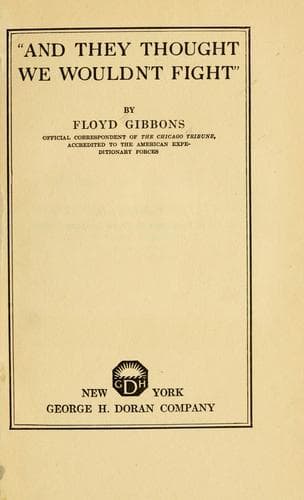
"And they thought we wouldn't fight"Gibbons, Floyd Phillips
History
"And they thought we wouldn't fight"
Gibbons, Floyd Phillips
World War, 1914-1918 -- Campaigns -- Western Front; World War, 1914-1918 -- Personal narratives
This was the fact, for immediately the oncoming vessel flashed on its
green and red sidelights and we saw it was headed for our position. We
floated off its stern for a while as it manoeuvred for the best
position in which it could take us on with a sea that was running higher
and higher.
The risk of that rescuing ship was great, because there was every reason
to believe that the submarine that had destroyed the _Laconia_ still
lurked in the darkness nearby, but those on board took the risk and
stood by for the work of rescue.
"Come along side port!" was megaphoned to us. As fast as we could, we
swung under the stern and felt our way broadside toward the ship's side.
Out of the darkness above, a dozen small pocket flashlights blinked down
on us and orders began to be shouted fast and thick.
When I look back on the night, I don't know which was the more
hazardous, going down the slanting side of the sinking _Laconia_ or
going up the side of the rescuing vessel.
One minute the swells would lift us almost level with the rail of the
low-built patrol boat and mine sweeper, but the next receding wave would
swirl us down into a darksome gulf over which the ship's side glowered
like a slimy, dripping cliff.
A score of hands reached out and we were suspended in the husky,
tattooed arms of those doughty British Jack Tars, looking up into their
weather-beaten youthful faces, mumbling our thankfulness and reading in
the gold lettering on their pancake hats the legend, "H. M. S.
_Laburnum_." We had been six hours in the open boat.
The others began coming alongside one by one. Wet and bedraggled
survivors were lifted aboard. Women and children first was the rule.
The scenes of reunion were heart-gripping. Men who had remained
strangers to one another aboard the _Laconia_, now wrung each other by
the hand or embraced without shame the frail little wife of a Canadian
chaplain who had found one of her missing children delivered up from
another boat. She smothered the child with ravenous mother kisses while
tears of gladness streamed down her face.
Boat after boat came alongside. The water-logged craft containing the
Captain came last.
A rousing cheer went up as he stepped on the deck, one mangled hand
hanging limp at his side.
The sailors divested themselves of outer clothing and passed the
garments over to the shivering members of the _Laconia's_ crew.
The cramped officers' quarters down under the quarter deck were turned
over to the women and children. Two of the _Laconia's_ stewardesses
passed boiling basins of navy cocoa and aided in the disentangling of
wet and matted tresses.
The men grouped themselves near steam-pipes in the petty officers'
quarters or over the grating of the engine rooms, where new life was to
be had from the upward blasts of heated air that brought with them the
smell of bilge water and oil and sulphur from the bowels of the vessel.
Public-domain text, read in full here on John Shaqi.
Reviews
Reviews
No reviews yet
Be the first to share your thoughts on this work.
Join the Discussion
Join the discussion
Sign in to leave a comment or review.
Sign InorCreate an account