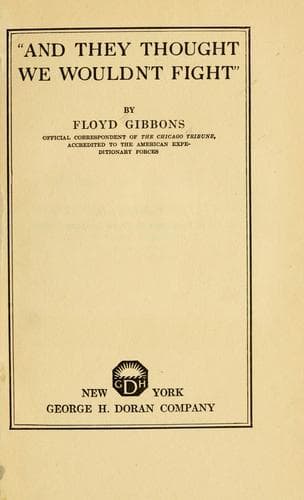
"And they thought we wouldn't fight"Gibbons, Floyd Phillips
History
"And they thought we wouldn't fight"
Gibbons, Floyd Phillips
World War, 1914-1918 -- Campaigns -- Western Front; World War, 1914-1918 -- Personal narratives
The injured--all minor cases, sprained backs, wrenched legs or mashed
hands--were put away in bunks under the care of the ship's doctor.
Dawn was melting the eastern ocean grey to pink when the task was
finished. In the officers' quarters, which had now been invaded by the
men, the roll of the vessel was most perceptible. Each time the floor of
the room slanted, bottles and cups and plates rolled and slid back and
forth.
On the tables and chairs and benches the women rested. Sea-sick mothers,
trembling from the after-effects of the terrifying experience of the
night, sought to soothe their crying children.
Then somebody happened to touch a key on the small wooden organ that
stood against one wall. This was enough to send some callous seafaring
fingers over the ivory keys in a rhythm unquestionably religious and so
irresistible under the circumstances that, although no one seemed to
know the words, the air was taken up in a reverent, humming chant by all
in the room.
At the last note of the Amen, little Father Warring, his black garb
snaggled in places and badly soiled, stood before the centre table and
lifted back his head until the morning light, filtering through the
opened hatch above him, shown down on his kindly, weary face. He recited
the Lord's prayer and all present joined. The simple, impressive service
of thanksgiving ended as simply as it had begun.
Two minutes later I saw the old Jewish travelling man limping about on
one lame leg with a little boy in his arms. He was collecting big, round
British pennies for the youngster.
A survey and cruise of the nearby waters revealed no more occupied boats
and our mine sweeper, with its load of survivors numbering two hundred
and sixty-seven, steamed away to the east. A half an hour steaming and
the vessel stopped within hailing distance of two sister ships, toward
one of which an open boat manned by jackies was being pulled.
I saw the hysterical French actress, her blonde hair wet and bedraggled,
lifted out of the boat and carried up the companionway. Then a little
boy, his fresh pink face and golden hair shining in the morning sun, was
passed upward, followed by some other survivors, numbering fourteen in
all, who had been found half-drowned and almost dead from exposure in a
partially wrecked boat that was picked up just as it was sinking. It was
in that boat that one American woman and her daughter died. One of the
survivors of the boat told me the story. He said:
"Our boat was No. 8. It was smashed in the lowering. I was in the bow.
Mrs. Hoy and her daughter were sitting toward the stern. The boat filled
with water rapidly.
"It was no use trying to bail it out. There was a big hole in the side
and it came in too fast. The boat's edge sank to the level of the water
and only the air-tanks kept it afloat.
"It was completely awash. Every swell rode clear over our heads and we
had to hold our breath until we came to the surface again. The cold
water just takes the life out of you.
Public-domain text, read in full here on John Shaqi.
Reviews
Reviews
No reviews yet
Be the first to share your thoughts on this work.
Join the Discussion
Join the discussion
Sign in to leave a comment or review.
Sign InorCreate an account