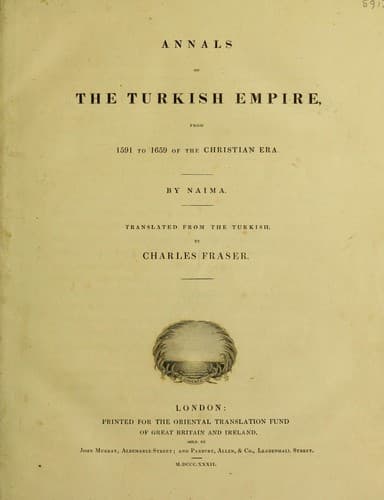
Annals of the Turkish Empire, from 1591 to 1659Naima, Mustafa
History
Annals of the Turkish Empire, from 1591 to 1659
Naima, Mustafa
Turkey -- History -- 1453-1683
Khoja Effendí (_i.e._ Sa’d-ud-dín), the new mufti, Ghaznafer Aghá,
and Ternakjí Aghá, all three joined in accusing Hasan Páshá. They
represented his conduct with regard to the queen-mother, and the other
enormities of his life, in such a clear light before the emperor, as
showed him to be worthy of death. He was accordingly seized on the 2d
of Ramazán, conveyed on board a vessel, and was conducted to the Seven
Towers by Ferhád Aghá, the chief of the Bostánjís, and in five or six
days afterwards he was strangled during the night. The ághá of the
Janissaries, Ternakjí Hasan Aghá, sealed the doors of his palace, and
transferred the whole of his property to the imperial coffers; but it
did not amount to what was anticipated.
_Jeráh Mohammed Páshá raised to the premiership._
The grand vezírship having again become vacant, there was some
disposition shown to recall Ibrahím Páshá to that important office;
but by the dexterity of the reverend prelate, his old enemy, this was
thwarted, and Jeráh Mohammed Páshá was appointed to fill that high
station.
_The enemy gains advantage at Yanuk by stratagem._
The city and fortress of Yanuk about this time was put under the
government of Mahmúd Páshá, who had formerly been ághá of the
Janissaries, and subsequently beglerbeg of Fajir. The enemy permitted
no grain of any kind to be brought or conveyed to Yanuk, but in order
to corrupt and pervert the inhabitants, as well as the troops who were
in it, they permitted great quantities of wine to be carried thither
both in boats and waggons. In consequence of this traffic in wine, the
people of Yanuk acquired the habit of drinking, and so very relaxed did
they become, that their ramparts and gates were no longer watched with
that care and vigilance which was the case before wine was introduced
amongst them. Regardless alike of the Páshá’s warnings as of every
other advice, they vainly confided in the natural and artificial
strength of the place, and were no longer the active vigilant men they
used to be.
The beglerbeg of Yanuk was in the habit of receiving from the sanják of
Petcheví an annual quantity of grain, amounting to two or three hundred
waggons, but which, when returning, were frequently intercepted by the
enemy, who on all such occasions carried off the oxen. In this way
above five or six thousand of these animals had been stolen at various
times, and driven away into the enemy’s dominions. This great loss the
people of the sanják of Petcheví were obliged to sustain; but other
districts fared worse, and had not even so much as one left them. In
fact, some of the peasants were under the necessity of ploughing their
lands by their own strength and that of their wives.
Public-domain text, read in full here on John Shaqi.
Reviews
Reviews
No reviews yet
Be the first to share your thoughts on this work.
Elsewhere in the archive
Join the Discussion
Join the discussion
Sign in to leave a comment or review.
Sign InorCreate an account