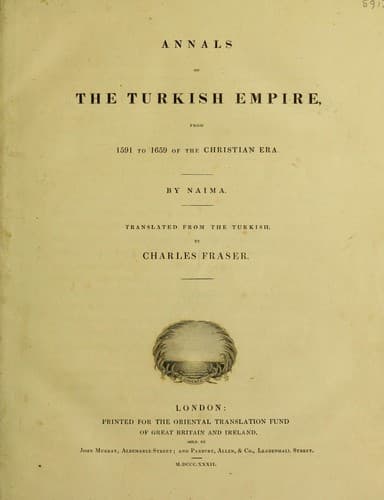
Annals of the Turkish Empire, from 1591 to 1659Naima, Mustafa
History
Annals of the Turkish Empire, from 1591 to 1659
Naima, Mustafa
Turkey -- History -- 1453-1683
About the commencement of the month of Ramazán this year, the enemy
committed great cruelty and excess. They attacked several hundreds of
waggons which were carrying provisions to Yanuk and Agria. The escort
of cavalry which accompanied these waggons, on seeing the enemy,
fled, leaving the poor drivers to shift for themselves. The number of
these amounted to about three hundred, who were either killed or made
prisoners. Between one and two thousand oxen and waggons were carried
off by the enemy.
The two thousand regular troops, and the two thousand Kúl-oghláns,
which had been left to garrison Yanuk, had most of their families in
the districts of Petcheví, Koban, and Alba Julia, and were therefore
strongly inclined on this account to abandon Yanuk altogether. The
fortress of Tata, which the year before had been demolished, and its
inhabitants destroyed, was allowed to remain in its state of ruin and
dilapidation.
The people of Yanuk appeared to be bound over by some spell or
infatuation not easily accounted for, if we except their propensity
for wine, which brought its own punishment. A swine of the name of
Palghi, kapúdán of Komran, sent some thousands of his foot soldiers to
surround Yanuk, whilst he himself with a thousand or two of cavalry
made his way towards its gate. The inhabitants and garrison were in a
profound state of inactivity and carelessness, and knew nothing of the
enemy’s approach. The gate was barricaded only with a single bar of fir
wood, and their drawbridge was not let down. Some few of these apostate
infidels who came to attack the place approached about midnight to
the gate, and feigned an alarm. The centinel, a boy, awaking from his
sleep, asked, “Who’s there?” They replied: “We are come from Petcheví
with provisions, were very near meeting the enemy, and have with much
difficulty escaped to this place. They are still in hard pursuit of
us, and will soon have us in their power, unless you open your gate
and let us in. Open then the gate, and let in the waggons loaded with
provisions.” As this conversation with the watch ended, the rest came
forward with their wooden mortars and placed them in front of the gate,
whilst the boy said he would run and inform the kapújí, and did so.
The treacherous enemy lost no time, for the centinel was scarcely gone
when they attacked the gate, splintered it to pieces, and rushed in on
the devoted people: some were lying drunk, some asleep, and all in a
state of total negligence and unconcern. Now the work of destruction
commenced. The troops in it saw when it was too late their danger, but
the sight of the enemy only roused them to madness. They fought with
the most desperate fury, and perished in the conflict. Thus did Yanuk
fall into the hands of the execrated enemy. The stratagem succeeded.
Public-domain text, read in full here on John Shaqi.
Reviews
Reviews
No reviews yet
Be the first to share your thoughts on this work.
Elsewhere in the archive
Join the Discussion
Join the discussion
Sign in to leave a comment or review.
Sign InorCreate an account