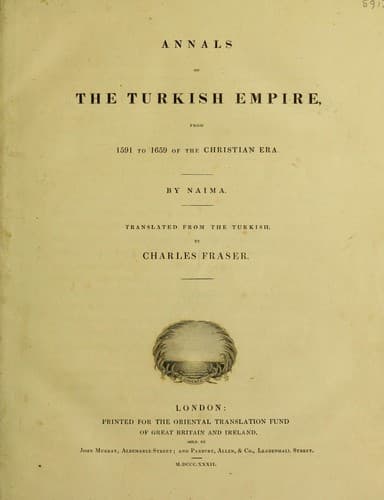
Annals of the Turkish Empire, from 1591 to 1659 — John Shaqi
Annals of the Turkish Empire, from 1591 to 1659Naima, Mustafa
History
Annals of the Turkish Empire, from 1591 to 1659
Naima, Mustafa
Turkey -- History -- 1453-1683
The inhabitants of Erzerúm having earnestly requested, by letters, to
be delivered from the oppression and tyranny of the Janissaries, who
had been sent among them during the winter, Ferhád Páshá, to put a
stop to these complaints, assured them in return that the Janissaries
would be recalled to their own odás within the empire. The inhabitants,
on receiving this intelligence, were elated: their proud and haughty
spirits were roused; and without giving any due time to the Janissaries
to prepare for their departure, or without exercising the least degree
of patience whatever, and in violation of the Páshá’s letter, they
commenced expelling the Janissaries, and loading them with every
species of reproach. A tumult ensued. Some of the Janissaries fell by
the hands of the inhabitants before the former had sufficient time
given them to evacuate the place.
This treatment, which was wholly occasioned by Ferhád’s letter,
awakened the wrath of the Janissaries, and led them to write letters
to their own odás and commanders complaining of the author of the
maltreatment they had met with. Accordingly the grand vezír, Ferhád
Páshá, who knew what he had to fear from the malevolence of the
Janissaries, rode boldly up to the Diván on the 20th of Jemadi II.,
and demanded to know whether the emperor (Sultán Murád Khán III.) had
given his consent to the orders sent to the Janissaries at Erzerúm
to murder him. The members of the council replied to this imperious
demand by immediately commencing an assault on the grand vezír;
and it was with no small difficulty that the officers of the vezír
succeeded in quieting the tumult and uproar which this circumstance
had occasioned. The members of the council, on peace being restored,
retired to their respective homes: but the affair was not yet ended;
for the emperor was no sooner informed of the disturbance which had
taken place in the diván, than he issued a royal mandate requiring
an explanation of the cause of it from his minister, Ferhád. The
minister, however, found himself inadequate to give a satisfactory
answer to the imperial demand; and therefore, instead of giving a fair
and candid statement of the whole affair, had recourse, from a defect
of judgment, to equivocation. Thinking the matter was now hushed, he
proceeded to depose and maltreat the ághá of the Janissaries, Satúrjí
Aghá; and appointed the armour-bearer, Khalíl Aghá, in his stead. The
very next day, however, the emperor, who had become acquainted with his
inconsistent and rash conduct, deposed him, and raised Síávush Páshá a
third time to the premiership.
_The Militia of Tabríz._
Public-domain text, read in full here on John Shaqi.
Reviews
Reviews
No reviews yet
Be the first to share your thoughts on this work.
Join the Discussion
Join the discussion
Sign in to leave a comment or review.
Sign InorCreate an account