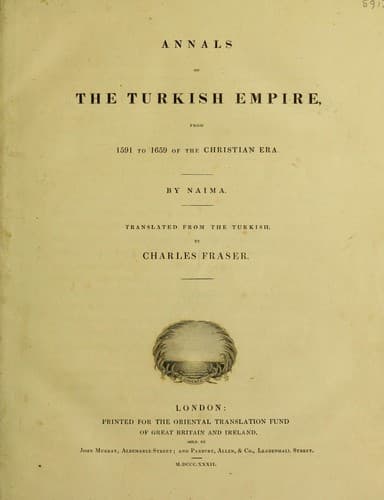
Annals of the Turkish Empire, from 1591 to 1659Naima, Mustafa
History
Annals of the Turkish Empire, from 1591 to 1659
Naima, Mustafa
Turkey -- History -- 1453-1683
The militia of Tabríz, malicious, corrupt, oppressive, and obstinate,
and ever skilful in stirring up rebellion, have always been disposed to
throw off the authority of their governors. The vezír Ja’fer Páshá, who
was this year governor of Tabríz and Azerbáíján, contrived and executed
a stratagem against them however, which ought to have taught them ever
afterwards to conduct themselves with propriety and good order. It
was this: Ja’fer Páshá, under the pretext of being obliged to go and
take cognizance of some other garrisons, left Tabríz, having secured a
sufficient number of troops from the Kúrd chiefs to come and assault
Tabríz. The Tabrízians on learning that an army of Kurds was come to
attack them rushed forth to give it battle, but were defeated with the
loss of 1,500 of their number. Ja’fer Páshá, on learning the success of
the Kurds, joined them with the volunteers under his own command, and
commenced a general slaughter of the Tabrízians, and thus punished them
most severely for their wickedness and insubordination.
_The Muftí Effendí, Bostánzádeh, deposed, and Zekeríá Effendí appointed
in his stead._
Husain Beg Zádeh says (in his history), that several disgraceful
complaints had been lodged with the emperor against the acute poet
Bákí Effendí, the military judge of Anatolia. As soon as Bákí Effendí
was made acquainted with this fact, and conjecturing that the mufti,
in order to get his own brother, cazí of Constantinople, appointed
in his room, would be excited to raise an accusation against him;
he, with great boldness, raised his voice in the diván and demanded
what these Bostáns (the mufti and his brother) wanted with him? The
elder of them, he said, was forty years of age, and was not yet able
either to repeat or read correctly. None of the decrees, continued he,
which he (the mufti) has written are in accordance with those already
collected and registered. Would it be just or wise, in order to get
Jamús, the mufti’s brother, put into his office, and for which he was
unfit, he asked, that complaints should be invented against him? This
speech was communicated to the mufti, who was so much nettled that
he instantly exhibited two hemistiches from Bákí’s poetical works,
which he declared evident blasphemy. A man, he said, who did not keep
himself free from that corruption ought by no means to hold any office,
sacred or profane. If Bákí, continued he, be not deposed, and not only
deposed but prosecuted, he (the mufti) would wander away to the utmost
bounds of the empire. Bákí Effendí, seeing the mufti had commenced
his vexatious proceedings against him, appealed to the grand vezír
and Khoja Sudur-úd-dín Effendí, and proposed to them to raise Zekeríá
Effendí to the office of mufti: or else to give that office to himself,
assuring them that he was competent to give forth daily, if requisite,
500 fetvás (judicial or religious decrees).
Public-domain text, read in full here on John Shaqi.
Reviews
Reviews
No reviews yet
Be the first to share your thoughts on this work.
Join the Discussion
Join the discussion
Sign in to leave a comment or review.
Sign InorCreate an account