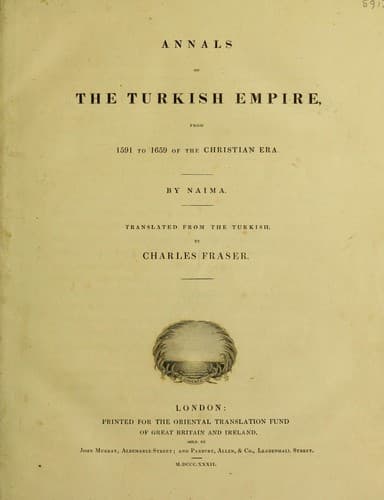
Annals of the Turkish Empire, from 1591 to 1659Naima, Mustafa
History
Annals of the Turkish Empire, from 1591 to 1659
Naima, Mustafa
Turkey -- History -- 1453-1683
The Janissaries and Spáhís who were present at the late victories
obtained over the enemy received an augmentation of salary for their
valour, and were ordered to return to Buda; the plains of which
they reached on the middle of Sefer, the day of Kásím, and where
distribution of provisions was made to the various troops. After this
was once over, the Ketkhodá of the Janissaries (_i. e._ the officer who
commanded the Janissaries in room of their Aghá, who was not present
in this war), placed two legions of Janissaries in the fortress of
Buda, ordered his arsenal, waggons, and other heavy baggage to be
moved forward to Pest, sent his remaining Janissaries to Segdin to
remain there during the winter, whilst all the other Aghás and writers
or secretaries remained with him at Buda. Ten days after Kásím day,
the Serdár, or commander-in-chief, gave orders to strike his tents,
and marched for Belgrade, where he went into winter-quarters, which,
however, he did not reach till the 17th of Rabia II. Rezván Aghá was
sent off to Constantinople to announce the victories which the Moslem
arms had obtained over the infidels: the young Spáhís were sent to
Nikboli (Nicopolis in Bulgaria), and the Salihdár of Widin was ordered
to take up his winter-quarters to the left of Belgrade.
_The Enemy advances to Belgrade._
The commander-in-chief, Sinán Páshá, had scarcely reached Belgrade,
when the Austrians appeared before it and fought an obstinate battle,
but were at last defeated. Many thousands of them perished, and their
cannon fell into the hands of the victorious Moslems. After they were
repulsed, Hasan Páshá collected all the troops scattered in Buda and
Pest, and in the country round about, and advanced to meet the enemy,
who had put themselves in order of battle. The enemy’s troops were
covered with steel, and had a very singular appearance. Their horsemen
had breast-plates of iron to shield them, and even their horses seemed
to be bound together by chains of the same metal.
Public-domain text, read in full here on John Shaqi.
Reviews
Reviews
No reviews yet
Be the first to share your thoughts on this work.
Join the Discussion
Join the discussion
Sign in to leave a comment or review.
Sign InorCreate an account