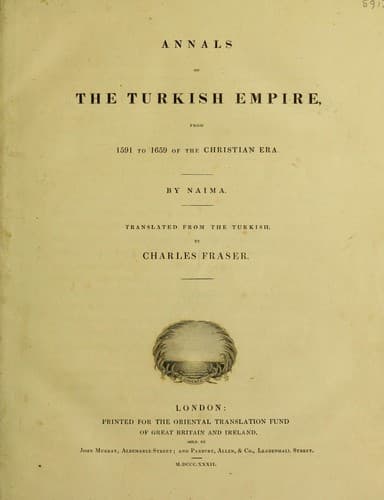
Annals of the Turkish Empire, from 1591 to 1659Naima, Mustafa
History
Annals of the Turkish Empire, from 1591 to 1659
Naima, Mustafa
Turkey -- History -- 1453-1683
When the enemy perceived the efforts which had been made by the
Moslems, and how they were preparing to meet them, they, thinking the
moment had arrived when they might easily and without resistance seize
on Buda, immediately after the first assault fled towards that city.
The brave Hasan, however, pursued them; and falling on them in the rear
hewed down a great many of them. The enemy, on perceiving the havoc
which Hasan and his heroic associates committed amongst them, marked
him out as the chief object of their hatred and vengeance, and their
swords were directed against him; but being covered with a coat of
mail, he for a while received no injury. Being excessively forward, and
impatient in carrying destruction among the enemy, he received at last
several wounds and fell from his horse. The commandant of the fortress,
Ahmed Aghá, a man of great heroism, handed him another, and though
wounded in several places he maintained his ground; and it was only
after long and continued acts of the greatest bravery that those around
him succeeded in getting him to retire from the scene of action. Those
of his followers, and who fought on foot, maintained the struggle till
night, and not one of them escaped alive from the field of battle. The
rest of his troops fled towards Buda and Pest, and Hasan himself was
carried in his wounded condition to Buda, whence he sent a report to
the Serdár at Belgrade of what had happened, and requested immediate
assistance.
_Felk falls into the hands of the Enemy._
After the defeat of the army of Buda the enemy retreated, and
after making a circuitous route, marched against Felk and besieged
it. Sinán Páshá, son of Mohammed Páshá, who had been sent by the
commander-in-chief, and a few strangers, five in all, moved slowly
forward to Felk and perceived the extremity to which the besieged were
reduced, and who in the end were necessitated to evacuate the fortress.
This took place on the first of Rabia II. The execrated infidels robbed
them of all the money and valuables they were possessed of before
leaving the place; and what is very remarkable, notwithstanding this
treatment, two or three hundred of them actually became apostates,
and were content to remain in Felk. But it must be observed, however,
that the majority of the people of Felk had a predilection for heresy,
and therefore the conduct of the apostates now mentioned need not be
much wondered at; though it must be confessed the innocent were also
infected by them.
It is also very remarkable that the spring of that year commenced
sooner than usual by two months, but it was short. The fruit trees were
soon covered over with blossoms, and in a short time afforded abundance
of fruit. By this fortuitous circumstance the hateful infidels were
enabled to subsist and pursue their hostile purposes, and they were but
too successful. Several castles and places of strength and importance
fell into their hands.
Public-domain text, read in full here on John Shaqi.
Reviews
Reviews
No reviews yet
Be the first to share your thoughts on this work.
Join the Discussion
Join the discussion
Sign in to leave a comment or review.
Sign InorCreate an account