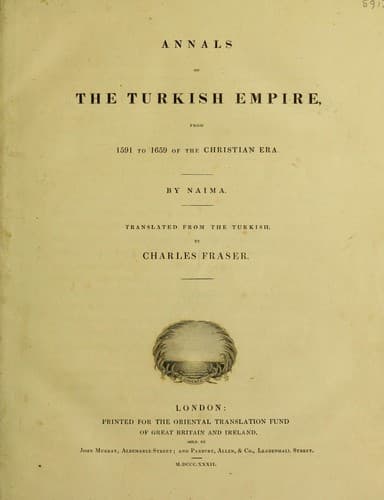
Annals of the Turkish Empire, from 1591 to 1659Naima, Mustafa
History
Annals of the Turkish Empire, from 1591 to 1659
Naima, Mustafa
Turkey -- History -- 1453-1683
When this auxiliary army drew near to Khutván, they perceived a
body of the enemy stationed on the banks of the river, which flowed
a little below the city on the north side; and therefore, with the
view of accomplishing their purpose, they on the 11th went about a
mile further up the river in order to cross. The enemy thought, when
they saw this, that the Moslems fled to escape them, and immediately
pursued after them and got in front of them, when a tremendous carnage
ensued. Mohammed Páshá and his corps of Spáhís stood back, whilst
Hasan Páshá with his veteran borderers was left to cope alone with
the infidel soldiery. In this desperate contest a very great number
of the iron-cased infidels perished, and almost the whole of the
heroic borderers fell martyrs. Hasan Páshá himself, like a furious
lion, brought incredible numbers of them to the ground. His clothes
unfortunately, in consequence of the bursting of a shell, caught
fire, but were extinguished without difficulty. From the explosion of
the gunpowder he was severely injured. The commander-in-chief of the
Moslem troops, Mohammed Páshá, son of the grand vezír, when he saw his
brave associates sorely pressed by the superior force of the enemy,
heartlessly and cowardly furled his banners, and returned with his
dastardly Spáhís to Buda. Just as the remaining Moslems were about
to retire in despair, the Beg of Ancora, Neïrání Páshá, issued most
fortunately from Khutván with a party, who attacked the enemy with
such fury as to drive them back with considerable loss both of men and
cannon. The larger guns he spiked. The enemy, however, soon recovered
themselves, and returned with greater vigour and renewed strength, and
continued the siege of Khutván till the month of Ramazán, when they
became altogether disheartened. The prudence and skill of the besieged
was too much for them.
In this battle 4,000 Moslems fell martyrs, and very many of the
infidels perished. When the account of this day’s transactions was
transmitted to the court of Constantinople, the glory and honour which
Hasan Páshá had most certainly gained would have been honourably
acknowledged; but by the grand vezír’s influence, the honour and
distinction which ought to have been conferred on Hasan Páshá was
awarded to his own son Mohammed Páshá. Besides an augmentation of
authority, he received a splendidly ornamented sword set in jewels, and
a handsome robe of fur, which was sent him by the emperor.
_The Siege of Osterghún._
Public-domain text, read in full here on John Shaqi.
Reviews
Reviews
No reviews yet
Be the first to share your thoughts on this work.
Join the Discussion
Join the discussion
Sign in to leave a comment or review.
Sign InorCreate an account