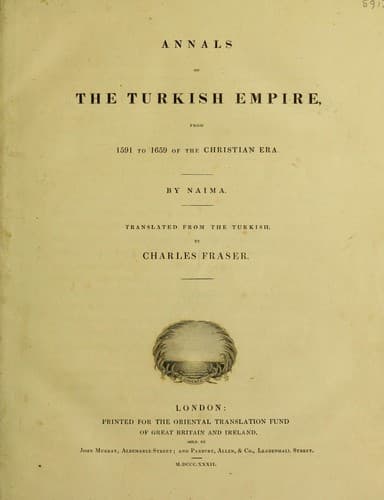
Annals of the Turkish Empire, from 1591 to 1659Naima, Mustafa
History
Annals of the Turkish Empire, from 1591 to 1659
Naima, Mustafa
Turkey -- History -- 1453-1683
The body of troops sent to lay siege to Osterghún was afterwards
largely augmented by those other troops which had been engaged
against Khutván, and the siege began to assume a regular appearance
in the month of Shabán. The peasants and villagers, encouraged by
the presence of the enemy, declared in their favour, and committed
enormous excesses. About the end of this month another body of the
enemy attacked the city of Wáj, slew several of the inhabitants, and
carried off about forty or fifty horsemen, besides a number of Martloos
(Christian) women and children.
Some time previous to this, 2,000 horsemen, sent from Bosnia and
Semendria, were appointed to settle themselves any where about
Osterghún, and were allowed to profit by any thing the chance of war
might put in their way. These perfidious wretches, however, entered
into a treacherous correspondence with the enemy, who had, by that
time, surrounded the city. They shot at the rate of 1,800 cannon-balls
per day against the walls of the city and fortress.
In the mean time a body of experienced Janissaries and other troops
were sent to their assistance. Three times did the Beg of Rhodes
convey to them, in galleys and other boats, timely aid; and completely
prevented the enemy from benefiting by any assistance sent them by
water, besides a variety of other important services which he had
rendered to the besieged.
The enemy, intent on reducing Osterghún, and after several days’
battering with their cannon, at length commenced an assault, but
were driven back with immense loss. The Hungarians, who acted at
some considerable distance, directed their guns against the place,
and succeeded in laying several portions of the walls level with the
ground. They now attempted to deceive. They told a thousand idle
stories about the propriety of following the example of the people of
Felk and Novograde, and thus to yield and give up the fortress; but
the heroic Moslems answered: “We are Romelian heroes and true-hearted
veterans, and shall never yield nor give up the place: we are resolved
on continuing our resistance. Behold, you accursed! you deride us by
saying that an army of Tátárs, riding on tortoises, are coming to our
aid; but we are sure of immense succours from Buda, either to-day or
tomorrow: and then we shall be swine if we don’t mount you all on
tortoises and send you to hell.” Such was the reply of the besieged
to the enemy, who finding their fraudulent attempts to deceive were
in vain, pushed on the siege with all their vigour, and advanced to a
third general assault. Among their leaders one was observed who was
very active in stimulating the soldiery on to the assault, and who wore
a breast-plate, and a gold chain suspended from his neck. The Beg of
Osterghún observed to those around him, that if that execrated wretch
could be disposed of, the infidel army would immediately retreat.
“Whoever lays him flat in the dust,” said he, “shall receive a sanják,
Public-domain text, read in full here on John Shaqi.
Reviews
Reviews
No reviews yet
Be the first to share your thoughts on this work.
Join the Discussion
Join the discussion
Sign in to leave a comment or review.
Sign InorCreate an account