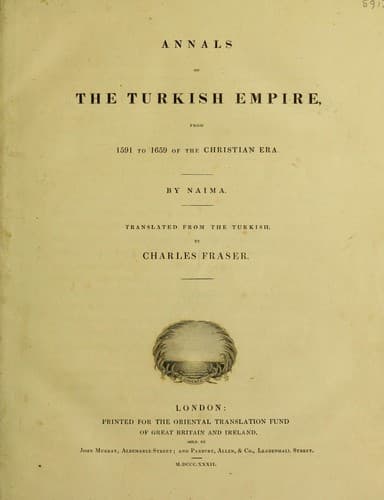
Annals of the Turkish Empire, from 1591 to 1659Naima, Mustafa
History
Annals of the Turkish Empire, from 1591 to 1659
Naima, Mustafa
Turkey -- History -- 1453-1683
In consequence of the several disasters which the Moslem arms had
sustained during the late spring, the evils and oppressions to which
the garrisons on the frontiers had been exposed, and also because
the contest was not yet ended, the mind of the grand vezír, when he
considered all these things, was very much afflicted; and therefore,
as the most effectual remedy for his grief, and for securing a more
favourable state of things, he sent, at once, an account of the whole
state of matters, and also a statement of the finances, and that of
the army, to the court of Constantinople. The grand vezír found, it
would appear, that military movements were a difficult thing to attend
to, especially every time a fixed period was necessary to be observed
with respect to those movements. Besides, the army of Romeili had been
precluded from attending to their harvest. In short, all these things
together had a powerful effect on Sinán Páshá’s mind, and led him to
regret his having had any thing to do with the war at all.
In these circumstances, and being no way prepared to prosecute the
war, he called together his emírs, commanders of castles, chiefs of
the army, nobles, and other great and learned men, to consult them
as to the steps which ought, in their situation, to be adopted. But
fortunately, at this time, the succours, as to men and money, which his
letters requested from the government of Constantinople, were hastening
towards him.
It may be observed here, that it was not customary for the ághás of
the Janissaries to go forth to war, except along with the emperor. On
this occasion this rule was departed from, and Sáleh Mohammed Páshá was
appointed to conduct the Janissaries to join the grand vezír Ibrahím
Aghá, superintendent of the armoury, with a thousand men-at-arms, and a
sufficient number of portable tents were attached to this expedition.
They set out for Belgrade on the 1st of Rajab. On the Segbán Báshí, the
commander of the guard, devolved the duties belonging to Sáleh Mohammed
Páshá’s office during his absence from Constantinople.
Before these arrangements took place, however, Kapúdán Jeghala Zádeh
was ordered out to sea with a fleet of five galleys carrying troops,
who reached the Mediterranean before the middle of Shabán. Ghází Gheráí
Khán of the Crimea, was also required to join the grand vezír, and
assist him by his counsels and by his arms.
Public-domain text, read in full here on John Shaqi.
Reviews
Reviews
No reviews yet
Be the first to share your thoughts on this work.
Join the Discussion
Join the discussion
Sign in to leave a comment or review.
Sign InorCreate an account