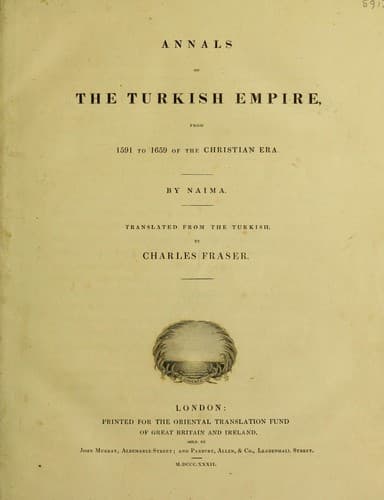
Annals of the Turkish Empire, from 1591 to 1659Naima, Mustafa
History
Annals of the Turkish Empire, from 1591 to 1659
Naima, Mustafa
Turkey -- History -- 1453-1683
and whatever else he may ask.” This was so sooner uttered than one
Osmán, a brave man, and an excellent marksman, levelled his piece
at the gold-chained infidel, cried “Yá allah,” and in a moment shot
him through the breast, when he sank from his horse, and was dragged
along the ground. The besiegers were now panic-struck, and retired
in the greatest precipitation towards their fortifications; but were
hotly pursued by the veteran Moslems, who rushed out after them,
and slew very many of them. The enemy, however, soon rallied again.
Every peasant in the country round about, able to handle a sword,
was collected; and with this augmentation of new strength they again
returned to the siege and work of destruction. The unfortunate Moslems,
notwithstanding the heroism they had displayed, and the firmness with
which they had acted, were at length, by famine and hard labour,
reduced to complete weakness; whilst the troops acting under the King
(of Hungary) joined the besiegers. Thus strengthened, the enemy began
to set the city on fire in several places.
At this critical moment an army under the command of the válís of
Temishvar and Bosnia, and which had been sent off by order of the
Serdár in the month of Ramazán, reached Pest in time enough to hear
the sound of the cannon from Osterghún; but it was the middle of
the month before the vanguard of this army advanced so far as to be
discovered by the enemy. This new appearance of assistance in favour
of the Moslems in the city of Osterghún so dismayed the enemy, that
they immediately relinquished their object, forsook their tabúr or
fortifications, and fled away in the utmost precipitation. Now was the
time for taking revenge. The Moslems, like raging wolves, rushed out of
their strong-hold, slew about a thousand of the enemy, did what damage
they were able to their fortifications, took a number of captives,
spiked their field-pieces, seized all the powder and goods they could
easily carry, set fire to what remained, and returned to the city in
triumph with the spoil they had taken. But the enemy, after recovering
from the panic into which they had been put, and after the army which
had come from Buda had returned back, retraced their steps, and again
took possession of their tabúr or fortifications, exercising violence
and cruelty on those who had been hired by the month in the villages
belonging to Buda.
Before finishing this paragraph we must add, by way of postscript,
that the enemy continued their hostile operations against Khutván
and Osterghún till they learned that the grand vezír was marching
with the royal army to Buda, when they removed to Komran, where they
concentrated their forces. The Válí of Temishvar who had came to aid
the city of Osterghún, and who was at this time in Pest, heard that a
palanka in his own government had revolted and declared for the enemy.
He returned and executed the whole of them.
_The Request of the Prime Minister—the Succour of the Magnificent
Emperor._
Public-domain text, read in full here on John Shaqi.
Reviews
Reviews
No reviews yet
Be the first to share your thoughts on this work.
Join the Discussion
Join the discussion
Sign in to leave a comment or review.
Sign InorCreate an account