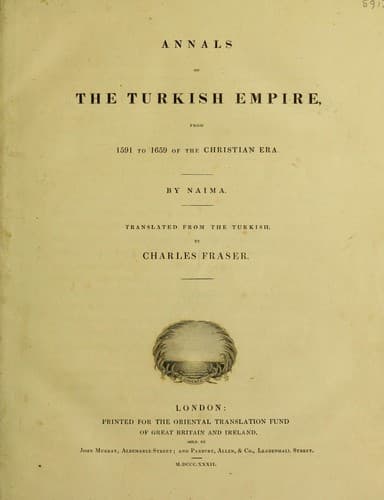
Annals of the Turkish Empire, from 1591 to 1659Naima, Mustafa
History
Annals of the Turkish Empire, from 1591 to 1659
Naima, Mustafa
Turkey -- History -- 1453-1683
The above Alí Ján relates the following story about himself: “On
retiring from the tribunal, and when I was outside of the city,” he
says, “I was met by an old acquaintance, an infidel, who accosted me
thus: ‘Alí Ján, you have been my friend for twenty years: do not let
the evening overtake you, nor remain at Yerkok; but hasten as fast
as you are able to Rusjuk, for all hope of accommodation is at an
end,’ and immediately went away.” The deputy, perceiving some strange
commotion and troops hastening towards the city, mounted his waggon,
and made the best of his way to Yerkok; but had scarcely time to give
the cazí an account of the affair in which he had been employed,
before these raggamuffian soldiery murdered every one of the Waivoda’s
creditors and every Mussulman in the place, and thence marched to
Yerkok, which they also attacked. “Seeing no alternative left me but
either to fall into the hands of these infidels, or make my escape,”
says Alí Ján in continuation of his story, “and being a good swimmer, I
immediately swam across the Danube. Another person swam across at the
same time, and we were the only persons of the inhabitants of Yerkok,
amounting to four thousand men, women, and children, that escaped being
either murdered or made prisoners. The city they afterwards burned to
the ground.”
These events, now recorded, took place in Jemadi 1. of 1002. Those
Musselmans that lived in Moldavia removed to Kili, to Ak-kermán, or to
Korsú, as they found most convenient. Some of the people of Rusjuk who
were present, and saw when these movements took place, sent an account
of the whole state of matters to the court of Constantinople, but the
Rusjukians themselves afterwards removed and dispersed themselves among
the Balkan mountains.
It being the winter season when these accounts reached the metropolis,
the operations of war were deferred till the spring of the year.
_Death of Sultán Murád III._
In Jemadi I. of 1003 of the Hijrah, the constitution of the deceased
emperor, now removed from this vain world to the distant light of God,
became so shattered and altered, as to receive no benefit whatever from
the skill and penetration of the medical faculty.
At the commencement of his disease, the grand vezír, Sinán Páshá went
in to see him into the palace at the very time when the singers or
chanters, and the females of the palace, were all collected in the
royal apartment; and though it was an exceedingly rare thing to read or
chant verses on such an occasion, yet, contrary to usual custom, the
Emperor ordered the following distich to be chanted:
I am afflicted, O Fate!
This night me watch, and me sustain.—[3]
Public-domain text, read in full here on John Shaqi.
Reviews
Reviews
No reviews yet
Be the first to share your thoughts on this work.
Join the Discussion
Join the discussion
Sign in to leave a comment or review.
Sign InorCreate an account