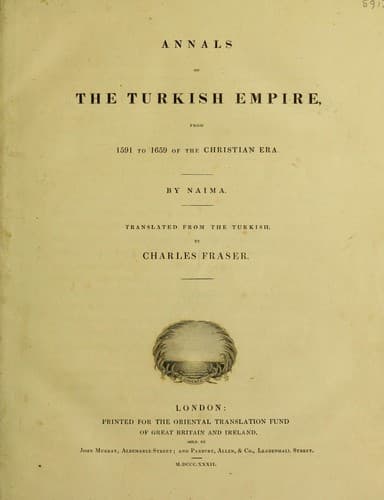
Annals of the Turkish Empire, from 1591 to 1659Naima, Mustafa
History
Annals of the Turkish Empire, from 1591 to 1659
Naima, Mustafa
Turkey -- History -- 1453-1683
At the time the Emperor departed this life, two vessels from Egypt
arrived before the royal fortress, and, according to ancient custom,
commenced firing their guns in token of rejoicing. But such was the
tremendous effect once and again which the concussion of the air, put
in motion by the explosions, had upon the mirrors in the apartment
next to the royal saloon, that they fell down from their places and
were shattered to pieces. When these mariners, however, were made
aware of what had taken place, and perceived the emblems of grief
and affliction, their joy was turned into sorrow, and tears began to
trickle down on their beards.
On the night of the 5th of Jemadi II., the remains of the Emperor were
carried from the bed of state to the table or board on which the dead
bodies are washed, and were afterwards consigned to a coffin and put
into a vault.
For nearly two weeks the vezírs and military judges could come to no
agreement among themselves how to act, with respect to settling the
government. At length, the Aghá of the royal house, without informing
any of the vezírs what he meant to do, and under the pretext of needing
some water, called the Bostánjí Báshí, Ferhád Aghá; informed him of
the secrets that were going on, and sent him with letters to the
heir-apparent, at that time in Magnesia, calling upon him to return
and ascend the throne of his ancestors. Two days after the above
messenger was sent off, one of the vezírs, Ibrahím Páshá, learning
the steps which the Aghá of the royal house had taken, immediately
sent off a letter to the prince by Súfí Osmán Aghá, who followed the
previous messenger close at his heels. Ferhád also, the governor or
Káímakám of Constantinople, on learning these manœuvres, wrote
officially to the young prince about his father’s death, and also
letters of congratulation: seeking by these means to screen himself
from all suspicion, and, at the same time, to ingratiate himself into
the prince’s favour. He also made several promotions; and the day after
sending off the above letter, he caused several criminals to be taken
out of prison and executed before the multitude, with the view of awing
them, and left their bodies exposed. His officers of police went about
the city and kept every thing quiet and in good order.
The young prince, Sultán Mohammed Khán, no sooner received intelligence
of his father’s demise than he set sail from Medeyna on the 16th of
Jemadi II., and landed near Sinán Páshá’s summer palace. Thence he
immediately went into the royal harem, where he had an interview with
his mother, and made arrangements for entering into mourning. His
inauguration was completed before Friday, the day of assembly (_i.e._
the Mohammedan sabbath), when it was necessary for him to attend the
mosque.
Public-domain text, read in full here on John Shaqi.
Reviews
Reviews
No reviews yet
Be the first to share your thoughts on this work.
Join the Discussion
Join the discussion
Sign in to leave a comment or review.
Sign InorCreate an account