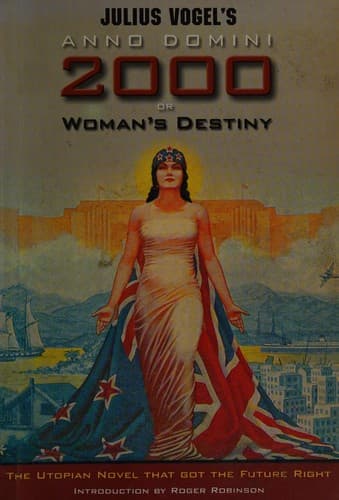
Anno Domini 2000; or, Woman's DestinyVogel, Julius, Sir
Science
Anno Domini 2000; or, Woman's Destiny
Vogel, Julius, Sir
Feminist fiction; New Zealand -- Fiction; Two thousand, A.D. -- Fiction; Utopian fiction; Utopias -- Fiction; Women -- Fiction
The increased enjoyment of mankind is a no less striking feature of the
last hundred years. Long since a general recognition was given to the
theory that, whilst equality of possession was an impossible and indeed
undesirable ideal, there should be a minimum of enjoyment of which no
human being should be deprived unless on account of crime. Crime as an
occupation has become unknown, and hereditary crime rendered impossible.
On the other hand, the law has constituted such provisions for reserves
of wealth that anything more than temporary destitution is precluded.
Such temporary destitution can only be the result of sheer improvidence,
the expenditure, for instance, within a day of what should be expended
in a week. The moment it becomes evident, its recurrence is rendered
impossible, because the assistance, instead of being given weekly, is
rendered daily. Private charity has been minimised; indeed, it is
considered to be injurious: and all laws for the recovery of debts have
been abolished. The decision as to whether there is debt and its amount
is still to be obtained, but the satisfaction of all debt depends solely
on the sense of honour or expediency of the debtor. The posting the
name of a debtor who refuses to satisfy his liabilities has been found
to be far more efficacious than any process of law.
The enjoyment of what in the past would have been considered luxuries
has become general. The poorest household has with respect to comforts
and provisions a profusion which a hundred years since was wanting in
households of the advanced classes.
Long since there dawned upon the world the conviction--
First. That labour or work of some kind was the only condition of
general happiness.
Second. That every human being was entitled to a certain proportion of
the world's good things.
Third. That, as the capacity of machinery and the population of the
world increased production, the theory of the need of labour could not
be realised unless with a corresponding increase of the wants of
mankind; and that, instead of encouraging a degraded style of living, it
was in the interests of the happiness of mankind to encourage a style of
living in which the refinements of life received marked consideration.
Great Britain, as it used to be called, has long ceased to be a bundle
of sticks. The British dominions have been consolidated into the empire
of United Britain; and not only is it the most powerful empire on the
globe, but at present no sign is shown of any tendency to weakness or
decay. Yet there was a time--about the year 1920--when the utter
disintegration of the Empire seemed not only possible, but probable.
Public-domain text, read in full here on John Shaqi.
Reviews
Reviews
No reviews yet
Be the first to share your thoughts on this work.
Join the Discussion
Join the discussion
Sign in to leave a comment or review.
Sign InorCreate an account