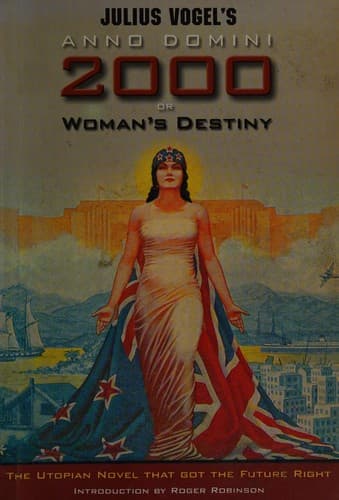
Anno Domini 2000; or, Woman's DestinyVogel, Julius, Sir
Science
Anno Domini 2000; or, Woman's Destiny
Vogel, Julius, Sir
Feminist fiction; New Zealand -- Fiction; Two thousand, A.D. -- Fiction; Utopian fiction; Utopias -- Fiction; Women -- Fiction
Hilda looked her thanks, but said no more than "Your opinion does not
surprise me, and it tallies with my own judgment."
"Dear girl, do not try to dispute that judgment. And now to affairs of
much importance. I have come from the Emperor, and I see great
difficulties in store for us."
Probably Hilda had never felt so grateful to Mrs. Hardinge as she did
now for the few words in which she had expressed so much, with such fine
tact. An appearance of sympathy or surprise would have deeply wounded
the girl.
"Dear mamma," she said--as sometimes in private in moments of affection
she was used to do--"does his Highness still show a disinclination to
the settlement to which he has almost agreed?"
"He shows the most marked disinclination, for he told me with strong
emotion that he felt he would be sacrificing the convictions of his
race."
The position of the Emperor was indeed a difficult one. A young,
high-spirited, generous, and brave man, he was asked by his Cabinet to
take a step which in his heart he abhorred. A short explanation is
necessary to make the case clear. When the Imperial Constitution of
Britain was promulgated, women were beginning to acquire more power; but
no one thought of suggesting that the preferential succession to the
direct heirs male should be withdrawn.
Meanwhile women advanced, and in all other classes of life they gained
perfect equality with regard to the laws of succession and other
matters, but the custom still remained by which the eldest daughter of
the Emperor would be excluded in favour of the eldest son. Some
negotiations had proceeded concerning the marriage of the Emperor to the
daughter of the lady who enjoyed the position of President of the United
States, an intense advocate of woman's equality. She was disposed, if
not determined, to make it a condition of the marriage that the eldest
child, whether son or daughter, should succeed. The Emperor's Cabinet
had the same view, and it was one widely held throughout the Empire.
But there were strong opinions on the other side. The increasing number
of women elected by popular suffrage to all representative positions and
the power which women invariably possessed in the Cabinet aroused the
jealous anger of men. True, the feeling was not in the ascendant, and
other disabilities of women were removed; but in this particular case,
the last, it may be said, of women's disabilities, a separate feeling
had to be taken into account. The ultra-Conservatives throughout the
Empire, including both men and women, were superstitiously tenacious of
upholding the Constitution in its integrity and averse to its being
changed in the smallest particular. They felt that everything important
to the Empire depended upon the irrevocable nature of the Constitution,
and that the smallest change might be succeeded by the most organic
alterations. The merits of the question mattered nothing in their
opinion in comparison with the principle which they held it was a matter
Public-domain text, read in full here on John Shaqi.
Reviews
Reviews
No reviews yet
Be the first to share your thoughts on this work.
Join the Discussion
Join the discussion
Sign in to leave a comment or review.
Sign InorCreate an account