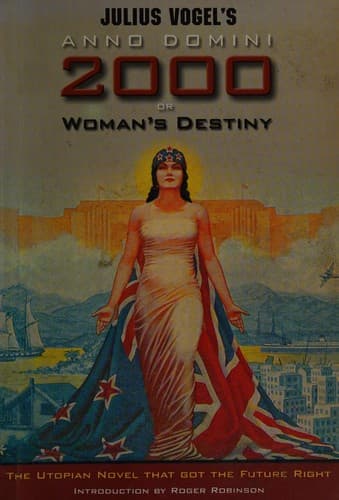
Anno Domini 2000; or, Woman's DestinyVogel, Julius, Sir
Science
Anno Domini 2000; or, Woman's Destiny
Vogel, Julius, Sir
Feminist fiction; New Zealand -- Fiction; Two thousand, A.D. -- Fiction; Utopian fiction; Utopias -- Fiction; Women -- Fiction
of life and death not to disturb.
It was now proposed to introduce a Bill to enable the Emperor to
declare that the succession should be to the eldest child. The Cabinet
were strongly in favour of it, and to a great extent their existence as
a Government depended on it. The Emperor was well disposed to his
present advisers, but, it was no secret, was strongly averse to this one
proposal. The contemplated match was an affair of State policy rather
than of inclination. He had seldom met his intended bride, and was not
prepossessed with her. She was good-looking and a fine girl; but she had
unmistakably red hair, an adornment not to his taste. Besides, she was
excessively firm in her opinions as to the superiority of women over
men; and he strongly suspected she would be for ever striving to rule
not only the household, but the Empire. It is difficult to fathom the
motives of the human mind, difficult not only to others, but to the
persons themselves concerned. The Emperor thought that his opposition to
placing the succession on an equality between male and female was
purely one of loyalty to his ancestors and to the traditions of the
Empire. But who could say that he did not see in a refusal to pass the
necessary Act a means of escaping the distasteful nuptials? Mrs.
Hardinge had come from a long interview with him, and it was evident
that she greatly doubted his continued support. She resumed, "His
Highness seems very seriously to oppose the measure, and indeed quite
ready to give up his intended marriage. I wonder," she said, looking
keenly at Hilda, "whether he has seen any girl he prefers."
The utter unconsciousness with which Hilda heard this veiled surmise
appeared to satisfy Mrs. Hardinge; and she continued, "Tell me, dear,
what do you think?"
"I am hardly in a position to judge. Does the Emperor give no reasons
for his opposition?"
"Yes, he has plenty of reasons; but his strongest appears to be that
whoever is ruler of the Empire should be able to lead its armies."
"I thought," said Miss Fitzherbert, "that he had some good reason."
"Do you consider this a good reason?" inquired Mrs. Hardinge sharply.
"From his point of view, yes; from ours, no," said Hilda gently, but
promptly.
"Then you do not think that we should retreat from our position even if
retreat were possible?"
"No," replied Hilda. "Far better to leave office than to make a
concession of which we do not approve in order to retain it."
"You are a strange girl," said Mrs. Hardinge. "If I understand you
rightly, you think both sides are correct."
Public-domain text, read in full here on John Shaqi.
Reviews
Reviews
No reviews yet
Be the first to share your thoughts on this work.
Join the Discussion
Join the discussion
Sign in to leave a comment or review.
Sign InorCreate an account