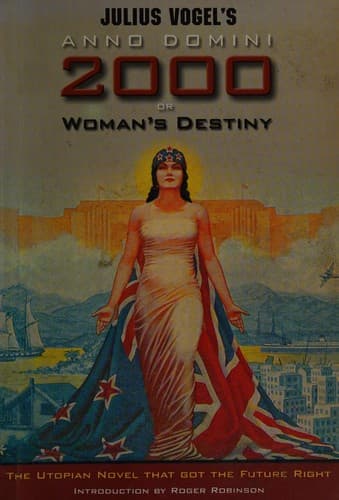
Anno Domini 2000; or, Woman's DestinyVogel, Julius, Sir
Science
Anno Domini 2000; or, Woman's Destiny
Vogel, Julius, Sir
Feminist fiction; New Zealand -- Fiction; Two thousand, A.D. -- Fiction; Utopian fiction; Utopias -- Fiction; Women -- Fiction
The Emperor was a tall man of spare and muscular frame, with the dignity
and bearing of a practised soldier. It was impossible not to recognise
that he was possessed of immense strength and power of endurance. He had
just celebrated his twenty-seventh birthday, and looked no more than
his age. His face was of the fair Saxon type. His eyes were blue,
varying with his moods from almost dark violet to a cold steel tint. Few
persons were able to disguise from him their thoughts when he fixed on
them his eyes, with the piercing enquiry of which they were capable. His
eyes were indeed singularly capable of a great variety of expression. He
could at will make them denote the thoughts and feelings which he wished
to make apparent to those with whom he conversed. Apart from his
position, no one could look at him without feeling that he was a
distinguished man. He was of a kindly disposition, but capable of great
severity, especially towards any one guilty of a mean or cowardly
action. He was of a highly honourable disposition, and possessed an
exalted sense of duty. He rarely allowed personal inclination to
interfere with public engagements; indeed, he was tenaciously sensitive
on the point, and sometimes fancied that he permitted his judgment to be
obscured by his prepossessions when he had really good grounds for his
conclusions. On the very subject of his marriage he was constantly
filled with doubt as to whether his objection to the proposed alteration
in the law of succession was well founded on public grounds or whether
he was unconsciously influenced by his personal disinclination to the
contemplated union. He realised the truth of the saying of a very old
author--
"Uneasy lies the head that wears a crown."
After indicating to Miss Fitzherbert his wish that she should be seated,
he said to her, "I have been induced to ask your attendance by a long
conversation I have had with Mrs. Hardinge. I have heard the opinions
she has formed, and they seem to me the result of matured experience. It
occurred to me that I would like to hear the opinions of one who,
possessed of no less ability, has been less subject to official and
diplomatic exigencies. I may gather from you how much of personal
feeling should be allowed to influence State affairs."
"Your Majesty is very gracious," faltered Hilda, "but Mrs. Hardinge has
already told you the opinion of the Cabinet. Even if I differed from it,
which I do not, I could not venture to obtrude my view on your Majesty."
"Yes, you could," said the Emperor, "if I asked you, or let me say
commanded you."
"Sir, your wishes are commands. I do not pretend to have deeply studied
the matter. I think the time has come to finally settle a long-mooted
question and to withdraw from woman the last disability under which she
labours."
"My objection," interposed the Emperor, "or hesitation is in no manner
caused by any doubt as to woman's deserving to be on a par with man in
every intellectual position."
Public-domain text, read in full here on John Shaqi.
Reviews
Reviews
No reviews yet
Be the first to share your thoughts on this work.
Join the Discussion
Join the discussion
Sign in to leave a comment or review.
Sign InorCreate an account