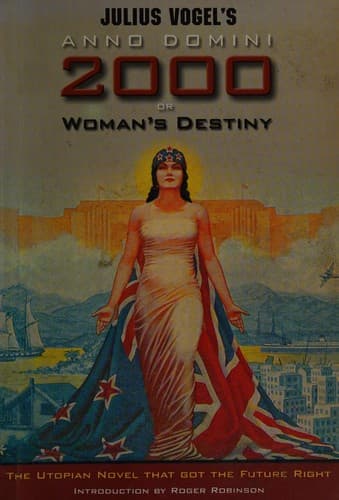
Anno Domini 2000; or, Woman's DestinyVogel, Julius, Sir
Science
Anno Domini 2000; or, Woman's Destiny
Vogel, Julius, Sir
Feminist fiction; New Zealand -- Fiction; Two thousand, A.D. -- Fiction; Utopian fiction; Utopias -- Fiction; Women -- Fiction
Mrs. Hardinge could not but feel surprise at the accuracy of the
Emperor's anticipation. She was sure he was not aware of Lord Reginald's
intention, and she knew that the latter was acting in revenge for the
slight he had received at the hands of Hilda Fitzherbert. She felt that
the prospect of the motion being carried was largely increased through
Lord Reginald having so cleverly appropriated it to himself. But it was
equally evident from the cordiality with which the proposal was received
that, if Lord Reginald had not brought it on, some one else would. She
saw also that the Countess of Cairo (the leader of the Opposition) had
rapidly decided to support Lord Reginald, though she might have
reasonably objected to his appropriating the subject. "He is clever,"
Mrs. Hardinge reflected. "He accurately gauged Lady Cairo's action. What
a pity neither Hilda nor I can trust him! He is as bad in disposition as
he is able in mind."
The next day, after the routine business was disposed of, Lord
Reginald's resolution was called on. That it excited immense interest
the crowded state of the hall in every part attested. Two of the
Emperor's aides-de-camp were there, each with a noiseless telegraph
apparatus in front of him to wire alternately the progress of the
debate. Reporters were similarly communicating with the _Argus_, _Age_,
and _Telegraph_ in Melbourne, and with the principal papers in Sydney,
Brisbane, Adelaide, and New Zealand.
Lord Reginald rose amidst loud cheers from the Opposition side of the
House. He made a temperate but exceedingly able speech. He would explain
before he concluded why he had taken the lead in bringing the question
on. Hitherto he had not sought to take a prominent place in politics. He
was a soldier by profession, and he would infinitely prefer
distinguishing himself as a soldier than as a politician; and, as he
would show, it was as a soldier that he came forward. He disclaimed any
hostility to the equality of the sexes or any objection to the
increasing power in public affairs to which women were attaining. He
fully recognised that the immense progress of the world during the last
hundred years was largely due to the intellectual advancement of women.
He equally rejected the idea that women were unfitted to rule over a
constitutionally governed empire.
Then he dwelt at great length on the inexpediency of permitting the
Constitution to be altered in any one particular, and this part of his
speech was warmly cheered by a considerable section on each side of the
Chamber. The effect of these remarks was, however, marred as far as the
Government party were concerned by a sneering reference to their
disposition to changes of all kinds; and he attempted a feeble joke by
insinuating that the most desirable change of all might be a change of
government.
Public-domain text, read in full here on John Shaqi.
Reviews
Reviews
No reviews yet
Be the first to share your thoughts on this work.
Join the Discussion
Join the discussion
Sign in to leave a comment or review.
Sign InorCreate an account