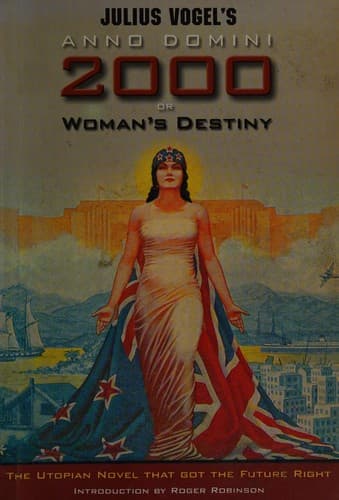
Anno Domini 2000; or, Woman's DestinyVogel, Julius, Sir
Science
Anno Domini 2000; or, Woman's Destiny
Vogel, Julius, Sir
Feminist fiction; New Zealand -- Fiction; Two thousand, A.D. -- Fiction; Utopian fiction; Utopias -- Fiction; Women -- Fiction
Then he came to his main argument and explained that it was this
consideration which had impelled him to take up the question. He was, as
he had said, a soldier; but he was not one who overlooked the misery
caused by war. He did not long for war, nor did he think that war was a
probable contingency; but he felt that the British Empire should always
be ready for war as the best means of avoiding it, and as a soldier he
believed no greater prestige could be given to the forces of their vast
dominions than the knowledge that the Emperor was ready to lead them in
person. "I would not," he said, "exclude the female line; but I would
not give it larger probabilities of succession than it enjoys at
present. Again, as a soldier I declare that the interests of the Empire
forbid our doing anything to limit the presence at the head of his
forces of the ruler of the Empire."
Lord Reginald sat down amidst cheers. He had been listened to with
profound attention, and parts of his speech were warmly applauded.
Still, on the whole, the speech was not a success. Every one felt that
there was something wanting. The speaker seemed to be deficient in
sincerity. The impression left was that he had some object in view. The
malign air with which the little joke was uttered about a change of
government was most repelling. It came with singularly bad grace from
one who tried to make out that he was unwillingly forced into opposition
to a Government with which he had been friendly.
Mrs. Hardinge rose amidst loud and continuous cheers. She combated each
argument of the last speaker. She admitted her great disinclination to
change the Constitution, but, she asked, was reverence for the
Constitution promoted by upholding it on the ground not of its merits,
but of the inexpediency of varying it? She freely admitted that her
feelings were in favour of changing the laws of succession, but she had
not brought forward any proposal to that effect, nor, as an advocate of
a change, did she see any immediate or early need of bringing down
proposals. Was it a good precedent to make great Ministerial changes
depend on resolutions affecting not questions before the House, not
proposals made by the Government, but sentiments or opinions they were
supposed to entertain? This was a great change in parliamentary
procedure, a larger one than those changes which the noble lord had
sneeringly credited her with advocating. Then she gave Lord Reginald a
very unpleasant quarter of an hour. She pictured him as head of the
Government in consequence of carrying his resolution; she selected
certain unpopular sentiments which he was known to entertain, and,
amidst great laughter, travestied Lord Reginald's defence of his fads
in response to resolutions of the same kind as they were now discussing.
She grew eloquent even to inspiration in describing the abilities of the
female Sovereigns of the past. And as to the soldier's point of view she
Public-domain text, read in full here on John Shaqi.
Reviews
Reviews
No reviews yet
Be the first to share your thoughts on this work.
Join the Discussion
Join the discussion
Sign in to leave a comment or review.
Sign InorCreate an account