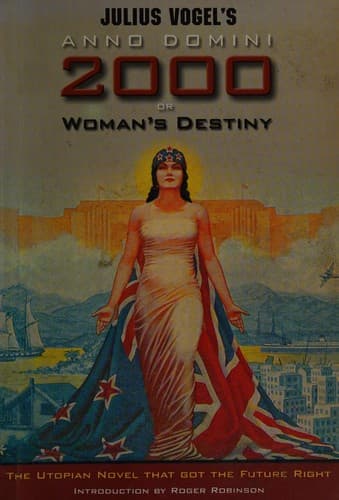
Anno Domini 2000; or, Woman's DestinyVogel, Julius, Sir
Science
Anno Domini 2000; or, Woman's Destiny
Vogel, Julius, Sir
Feminist fiction; New Zealand -- Fiction; Two thousand, A.D. -- Fiction; Utopian fiction; Utopias -- Fiction; Women -- Fiction
"You are of that," replied the Emperor, "of course the best judge. But I
should not like so grave a step as the one which Mrs. Hardinge has felt
it her duty to take to be construed into a formality for effacing the
effect of a vote of the House. I am averse," said the wise ruler, "to
anything which might even remotely make me appear as the medium of, or
interferer with, parliamentary action. I esteem Mrs. Hardinge, and I
esteem you, Lady Cairo; but if the resignation now tendered to me went
no further than at present, it might justly be surmised that I had
permitted myself to be the means of strengthening what Mrs. Hardinge
considered an insufficient parliamentary confidence. I therefore ask you
not to give me a hasty answer, but to consult your friends and endeavour
to form a strong Government."
No more could be said. Lady Cairo, with becoming reverence, signified
her submission to the Emperor's wishes. She summoned her chief friends
and colleagues, and had many earnest conferences with them separately
and collectively. It was readily admitted that, if they formed a
Government, there was a considerable number of members who, though not
their supporters, would protect them in a fair trial. It was indeed
certain that Mrs. Hardinge would be too generous to indulge in factious
opposition, and that, if they avoided any notoriously controversial
measure, she would herself help them to get through the session. But
Lady Cairo was a large-minded statesman. She loved power, but, because
she loved it, was averse to exercising it on sufferance. She could not
but be sensible such would be her position, and that she would have to
trust less to the strength of her own party than to the forbearance of
her opponents. Besides, there was a point about which a great difference
of opinion existed. She could not attempt to form a Government unless in
combination with Lord Reginald, who moved the resolution. The animosity
he had displayed to the Government made it probable, almost certain,
that he would do what he could to aid her; it might even be expected
that he would induce all or nearly all of his followers to come over to
her; but again and again she asked herself the question would such an
alliance be agreeable to her? Joint action during an animated debate was
widely different from the continued intimacy of official comradeship.
She liked Lord Reginald no better than other persons liked him. She had
very clear perceptions, and was of a high and honourable nature. Lord
Reginald inspired her with distrust. It was his misfortune to awaken
that feeling in the minds of those persons with whom he came into
contact. Her most trusted colleagues were generally of the same opinion,
though several prominent members of the party thought it a mistake not
to accept the opportunity and test its chances.
Public-domain text, read in full here on John Shaqi.
Reviews
Reviews
No reviews yet
Be the first to share your thoughts on this work.
Join the Discussion
Join the discussion
Sign in to leave a comment or review.
Sign InorCreate an account