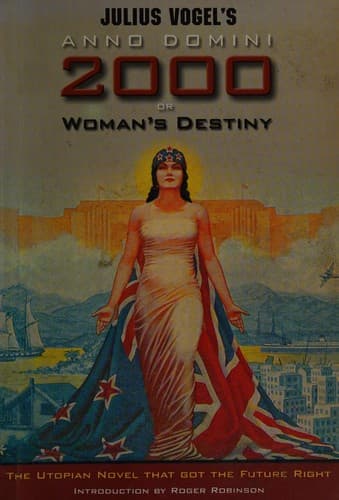
Anno Domini 2000; or, Woman's DestinyVogel, Julius, Sir
Science
Anno Domini 2000; or, Woman's Destiny
Vogel, Julius, Sir
Feminist fiction; New Zealand -- Fiction; Two thousand, A.D. -- Fiction; Utopian fiction; Utopias -- Fiction; Women -- Fiction
Her intimate friends expressed their opinion with diffidence. They would
not accept the responsibility of dissuading her from taking office. They
knew that it was a high position and one to which individually she would
do justice, and they knew also that many contingencies might convert a
Government weak at the outset into a strong one. But she could read
between the lines, the more especially that she shared the distrust at
which they hinted. Two of the colleagues she most valued went so far as
to leave her to understand that they would not join her Government,
though of course they would support it. They excused themselves on
private grounds; but she was shrewd enough to see these were the
ostensible, not the real, reasons. Lady Cairo was not one of those
persons who habitually try to persuade themselves to what their
inclinations lead. What she had said to the Emperor satisfied the most
fastidious loyalty. She was perfectly free to take office. No one could
question either her action or her motive. She need not fear the world's
opinion if she consulted her own inclination, and nineteen out of twenty
persons would have been satisfied. She was not; she still saw before her
the necessity of acting with one colleague at least, Lord Reginald, who
would be distasteful to her: and as a strong party statesman, she was
not well disposed generally to the bulk of his followers, whose
inclination led them to endeavour to hold the balance of power between
contending parties. She determined on consulting her aged mother, now a
confirmed invalid, but once a brilliant and powerful statesman, noted
for her high sense of honour.
"My dear," said this helpless lady when she had heard all her daughter
had to tell her, "no one but yourself can measure the strength or the
justice of the distaste you feel for the alliance you must make if you
accept the splendid responsibilities offered to you. But the distaste
exists, and it is not likely to become less. I doubt if you are
justified in disregarding it. Your time will come, my dear; and it will
be a pleasure to you to think that you have not sought it at the expense
of a personal sacrifice of doubts, that would not exist if all grounds
for them were wanting. You must decide. I will go no further than to say
this. I cannot persuade you to allow your inclination for office to
overrule your disinclination to a powerful section of those who must
share your responsibilities. It is sadly often the case that the
instinct to sacrifice inclination is more reliable than the disposition
to follow it."
Three days after their last interview the Emperor again received Lady
Cairo.
"Your Majesty, I have to decline, with great respect and much gratitude
for the confidence you reposed in me, the task of forming a Government
with which you graciously charged me."
Public-domain text, read in full here on John Shaqi.
Reviews
Reviews
No reviews yet
Be the first to share your thoughts on this work.
Join the Discussion
Join the discussion
Sign in to leave a comment or review.
Sign InorCreate an account