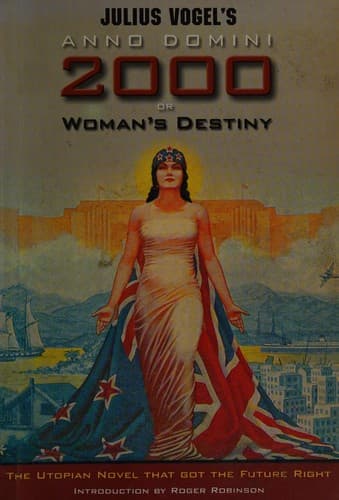
Anno Domini 2000; or, Woman's Destiny — John Shaqi
Anno Domini 2000; or, Woman's DestinyVogel, Julius, Sir
Science
Anno Domini 2000; or, Woman's Destiny
Vogel, Julius, Sir
Feminist fiction; New Zealand -- Fiction; Two thousand, A.D. -- Fiction; Utopian fiction; Utopias -- Fiction; Women -- Fiction
cradle to grave knew not what happiness meant, or made the start from a
higher elevation, upon which destitution was impossible, there would
still continue the climbing of myriads to greater heights and the
resting on plateaus of infinitesimally few; indeed, as poverty tended to
crush ambition, there would be a larger range of aspiration accompanying
an improvement in the condition of the lowliest class. And so it proved.
The system of government and taxation followed the theory of the range
above destitution. Taxes were exacted in proportion to the ability to
pay them. The payments for the many services the Post Office rendered
were not regarded as taxation. The customs duties were looked upon as
payments made in proportion to the desires of the people to use dutiable
goods. If high customs duties meant high prices, they also meant high
wages.
The Empire, following the practice of other countries, was utterly
averse to giving employment to the peoples of foreign nations. Every
separate local dominion within the Empire was at liberty to impose by
its legislature what duties it pleased as between itself and other parts
of the Empire, but it was imperatively required to collect three times
the same duties on commodities from foreign countries. This was of
course meant to be prohibitive of foreign importations, and was
practicable because the countries within the Empire could supply every
commodity in the world. It was argued that to encourage foreign
importations merely meant to pit cheap labour against the price for
labour within the Empire. Besides the customs duties, the revenue was
almost entirely made up of income tax and succession duties. Stamp
duties, as obstacles to business, were considered an evidence of the
ignorance of the past. The first five hundred pounds a year of income
was free; but beyond that amount the State appropriated one clear fourth
of all incomes. Similarly one quarter of the value of all successions,
real or personal, in excess of ten thousand pounds, was payable to the
State; and disposition by gifts before death came within the succession
values. A man or woman was compelled to leave half his or her property,
after payment of succession duty, in defined proportion to the children
and wife or husband, as the case might be, or failing these to near
relations; the other half he or she might dispose of at pleasure. It was
argued that to a certain extent the amasser of wealth had only a life
interest in it, and that it was not for the happiness of the successors
of deceased people to come into such wealth that the ambition to work
and labour would be wanting. The system did not discourage the amassment
of wealth; on the contrary, larger fortunes were made than in former
times. Higher prices gave to fortunes of course a comparatively less
purchasing power; but taking the higher prices into consideration, the
accumulation of wealth became a more honourable ambition and a
Public-domain text, read in full here on John Shaqi.
Reviews
Reviews
No reviews yet
Be the first to share your thoughts on this work.
Join the Discussion
Join the discussion
Sign in to leave a comment or review.
Sign InorCreate an account