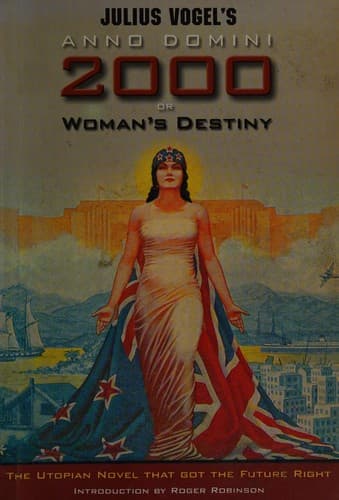
Anno Domini 2000; or, Woman's Destiny — John Shaqi
Anno Domini 2000; or, Woman's DestinyVogel, Julius, Sir
Science
Anno Domini 2000; or, Woman's Destiny
Vogel, Julius, Sir
Feminist fiction; New Zealand -- Fiction; Two thousand, A.D. -- Fiction; Utopian fiction; Utopias -- Fiction; Women -- Fiction
And now, after an interval of five years, the sovereigns of finance met
in conclave. In obedience to the generally expressed wish, Lord de
Cardrosse took the chair. "I need scarcely say," he began, "that I am
deeply sensible of the compliment you pay me in asking me to preside
over such a meeting. We in this room represent a living power throughout
the globe, before which the reigning sovereigns of the world are
comparatively helpless. But, because of our great strength, it is
undesirable that we should work unitedly except for very great and
humane objects. For the mere purpose of money-making, I feel assured you
all agree with me in desiring no combination, no monopoly, that would
pit us against the rest of the world."
He paused for a moment, evidently desiring to disguise the strength of
the emotion with which he spoke.
He resumed in slower and apparently more mastered words. "I wish I could
put it to you sufficiently strongly that our houses would not have
considered any good that could result to them and to you a sufficient
excuse for inviting such a combination. We hold that the only cause that
could justify it is the conviction that for the good of mankind a vast
power requires to be wielded which is not to be found in the ordinary
machinery of government."
A murmur of applause went round the table; and Mr. Demetrius, with much
feeling, said, "You make me very happy by the assurance you have given.
I will not conceal from you that our house anticipated as much, or it
would not have been represented. We are too largely concerned with
States in which free institutions are permanent not to avoid anything
which might savour of a disposition to combine financial forces for the
benefit of financial houses."
Lord de Cardrosse then proceeded to explain that his family, in serious
and prolonged conclave, could come to no other conclusion than that
certain influences were at work which would cause great suffering to
mankind and sap and destroy the best institutions which civilisation and
science had combined to create. The time had come to answer the
question, Should human knowledge, human wants, and human skill continue
to advance to an extent to which no limit could be put, or should the
survival of the fittest and strongest be fought out in a period of
anarchy?
"It amounts," he said in a tone of profound conviction, "to this: the
ills under which the masses suffer accumulate. There is no use in
comparing what they have to-day with what they had fifty years ago. A
person who grows from infancy to manhood in a prison may feel contented
until he knows what the liberty is that others enjoy. The born blind are
happier than those who become blind by accident. To our masses the
knowledge of liberty is open, and they feel they are needlessly deprived
of it. Wider and wider to their increasing knowledge opens out the
horizon of possible delights; more and more do they feel that they are
deprived of what of right belongs to them."
Public-domain text, read in full here on John Shaqi.
Reviews
Reviews
No reviews yet
Be the first to share your thoughts on this work.
Join the Discussion
Join the discussion
Sign in to leave a comment or review.
Sign InorCreate an account