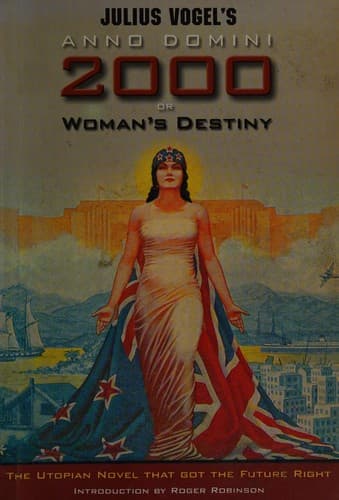
Anno Domini 2000; or, Woman's DestinyVogel, Julius, Sir
Science
Anno Domini 2000; or, Woman's Destiny
Vogel, Julius, Sir
Feminist fiction; New Zealand -- Fiction; Two thousand, A.D. -- Fiction; Utopian fiction; Utopias -- Fiction; Women -- Fiction
He paused, as if inviting some remarks from his hearers.
Mr. Bisdat, who spoke in an interrogative rather than an affirmative
tone, took up the thread.
"I am right, I think, in concluding that your remarks do not point
against or in favour of any school of politics or doctrines of party.
You direct our notice to causes below the surface to which the
Government of the day--I had almost said the hour,--do not penetrate,
causes which you believe, if left to unchecked operation, will undermine
the whole social fabric."
"It is so," emphatically replied Lord de Cardrosse. "The evils are not
only apparent; but equally apparent is it that no remedy is being
applied, and that we are riding headlong to anarchy."
Again he paused, and Mr. Rorgon took up the discussion. "If we," he
said, "the princes of finance, do not find a remedy, how long will the
enlarged intelligence of the people submit to conditions which are at
war with the theory of the equality and liberty of mankind?"
"Yes," said the Baroness de Cardrosse, speaking for the first time, "it
is clear that there is a limit to the inequality of fortune to which men
and women will submit. Equality of possessions there cannot be; but, if
I may indulge in metaphor, we cannot expect that the bulk of humankind
will be content with being entirely shut out from the sunlight of
existence."
The gentlemen present bowed low in approval; and Mr. Demetrius said,
"The simile of the Baroness is singularly appropriate. There are myriads
of human beings to whom the sunshine of life is denied. A too universal
evil invites resistance by means which in lesser cases might be scouted.
In short, if the remedy is left to anarchy, anarchy there will be. Even
in our young lands the shadow of the coming evil is beginning to show
itself. Indeed," he added, with an air of musing abstraction, "it is not
unfair to deduce from what has been said, that, even if the evils are
less in the new lands of the West and the South, superior general
intelligence may more than proportionally increase the wants of the
multitude and the sense of wrong under which they labour."
The conference extended over three days. Every one agreed that
interference with the ordinary conditions of finance was inexpedient
except in extreme cases, but they were unanimous in thinking that an
extreme case had to be dealt with. They finally decided by the use of an
extended paper currency, with its necessary guarantees, to increase the
circulating medium and to raise the prices both of products and labour.
Some other decisions were adopted having especial reference to the
employment of labour and insurance against want in cases of disablement
through illness, accident, or old age.
So ended the most remarkable conference of any age or time.
CHAPTER I.
THE YEAR 2000--UNITED BRITAIN.
Public-domain text, read in full here on John Shaqi.
Reviews
Reviews
No reviews yet
Be the first to share your thoughts on this work.
Join the Discussion
Join the discussion
Sign in to leave a comment or review.
Sign InorCreate an account