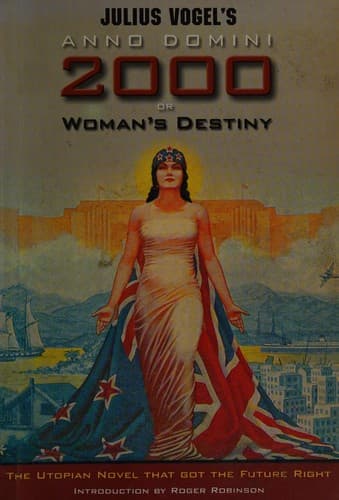
Anno Domini 2000; or, Woman's DestinyVogel, Julius, Sir
Science
Anno Domini 2000; or, Woman's Destiny
Vogel, Julius, Sir
Feminist fiction; New Zealand -- Fiction; Two thousand, A.D. -- Fiction; Utopian fiction; Utopias -- Fiction; Women -- Fiction
Singularly, it was Lord Gladstone Churchill, great-grandfather of the
present Chancellor of the Exchequer, who made the announcement, seventy
years previously, that the time had arrived for abandoning the free
trade which however he admitted had been of benefit to the parent
country prior to federation.
The proposed fiscal reforms were rapidly confirmed; and Parliament rose
towards the middle of December, in time to allow members to be present
at the great annual fête in Dublin. We have already described how it was
that the federation of the Empire, including local government in
Ireland, was brought about by the intervention of the Colonies. The
Irish people, warm-hearted and grateful, felt they could never be
sufficiently thankful. They would not allow the declaration of the
Empire to be so great an occasion of celebration, as the anniversary of
the day on which the premiers of the six Australasian colonies, of the
Dominion of Canada, and of the South African Dominion met and despatched
the famous cablegram which, after destroying one administration,
resulted in the federation of the empire of Britain. A magnificent group
representing these prime ministers, moulded in life-size, was erected,
and has always remained the most prominent object, in Dublin. The
progress of Ireland after the establishment of the Empire was
phenomenal, and it has since generally been regarded as the most
prosperous country in the world. Under the vivifying influence of
Protection, the manufactures of Ireland advanced with great strides.
Provisions were made by which the evils of absenteeism were abated.
Formerly enormous fortunes were drawn from Ireland by persons who never
visited it. An Act was passed by which persons owning large estates but
constantly absent from the country were compelled to dispose of their
property at a full, or rather, it might be said, an excessive, value.
The Government of Ireland declared that the cost of doing away with the
evils of absenteeism was a secondary consideration. The population of
Ireland became very large. Hundreds of thousands of persons descended
from those who had gone to America from Ireland came to the country,
bringing with them that practical genius for progress of all sorts which
so distinguishes the American people. The improvement of Ireland was
always in evidence to show the advantages of the federation of the
Empire and of the policy of making the prosperity of its own people the
first object of a nation.
Public-domain text, read in full here on John Shaqi.
Reviews
Reviews
No reviews yet
Be the first to share your thoughts on this work.
Elsewhere in the archive
Join the Discussion
Join the discussion
Sign in to leave a comment or review.
Sign InorCreate an account