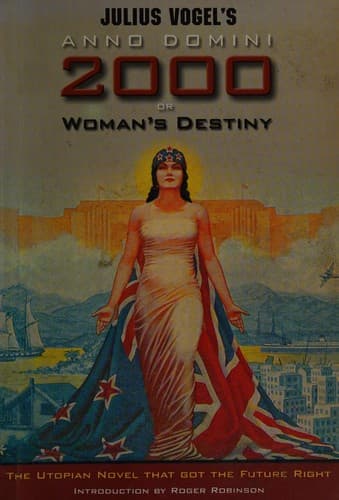
Anno Domini 2000; or, Woman's DestinyVogel, Julius, Sir
Science
Anno Domini 2000; or, Woman's Destiny
Vogel, Julius, Sir
Feminist fiction; New Zealand -- Fiction; Two thousand, A.D. -- Fiction; Utopian fiction; Utopias -- Fiction; Women -- Fiction
The Irish fête-day that year was regarded with even more than the usual
fervour, and that is saying a great deal. It was to be marked by a
historical address which Mrs. Hardinge had consented to deliver. Mrs.
Hardinge was the idol of the Irish. With the best blood of celebrated
Celtic patriots in her veins, she never allowed cosmopolitan or national
politics to make her forget that she was thoroughly Irish. She gloried
in her country, and was credited with being better acquainted with its
history and traditions than any other living being. She spoke in a large
hall in Dublin to thousands of persons, who had no difficulty in hearing
every note of the flexible, penetrating, musical voice they loved so
well. She spoke of the long series of difficulties that had occurred
before Ireland and England had hit upon a mode of living beneficial and
happy to both, because the susceptibilities of the people of either
country were no longer in conflict. "Undoubtedly," she said, "Ireland
has benefited materially from the uses she has made of local government;
but the historian would commit a great mistake who allowed it to be
supposed that aspirations of a material and sordid kind have been at the
root of the long struggle the Irish have made for self-government. I
put it to you," she continued, amidst the intense enthusiasm of her
hearers, "supposing we suffered from the utmost depression, instead of
enjoying as we do so much prosperity, and we were to be offered as the
price of relinquishing self-government every benefit that follows in the
train of vast wealth, would we consent to the change?" The vehement "No"
which she uttered in reply to her own question was re-echoed from
thousands of throats. She directed particular attention to what she
called the Parnell period. "Looked at from this distance," she said, "it
was ludicrous in the extreme. Government succeeded Government; and each
adopted whilst in office the same system of partial coercion, partial
coaxing, which it condemned its successor for pursuing. The Irish
contingent went from party to party as they thought each oscillated
towards them. Many Irish members divided their time between Parliament
and prison. The Governments of the day adopted the medium course: they
would not repress the incipient revolution, and they would not yield to
it. Agrarian outrages were committed by blind partisans and weak tools
who thought that an exhibition of unscrupulous ferocity might aid the
cause. The leaders of the Irish party were consequently placed on the
horns of a dilemma. They had either to discredit their supporters, or to
admit themselves favourable to criminal action. They were members of
Parliament. They had to take the oath of allegiance. They did not dare
to proclaim themselves incipient rebels." Then Mrs. Hardinge quoted,
amidst demonstrative enthusiasm, Moore's celebrated lines--
Public-domain text, read in full here on John Shaqi.
Reviews
Reviews
No reviews yet
Be the first to share your thoughts on this work.
Elsewhere in the archive
Join the Discussion
Join the discussion
Sign in to leave a comment or review.
Sign InorCreate an account