Women -- Massachusetts; Women -- Suffrage -- United States; Women's Anti-Suffrage Association of Massachusetts
Produced by Bryan Ness and the Online Distributed
Proofreading Team at https://www.pgdp.net (This book was
produced from scanned images of public domain material
from the Google Print project.)
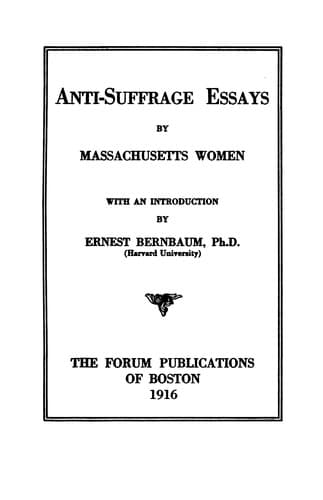
ANTI-SUFFRAGE
ESSAYS.
ANTI-SUFFRAGE ESSAYS
BY
MASSACHUSETTS WOMEN
WITH AN INTRODUCTION
BY
ERNEST BERNBAUM, Ph.D.
(Harvard University)
THE FORUM PUBLICATIONS
OF BOSTON
1916
Copyright, 1916, by
J. A. HAIEN
_All Rights Reserved_
_Gratefully Dedicated
to the 295,939 Massachusetts Men
Who, on Election Day, 1915
Endorsed the Anti-Suffrage Sentiments
of the Women of Massachusetts_
INTRODUCTION
THE ANTI-SUFFRAGE VICTORY IN MASSACHUSETTS
The essays in this little book are by anti-suffrage women who were
prominent speakers, writers, and organizers, in the campaign of 1915.
They voice sentiments which gained the largest measure of popular
support ever accorded in the history of Massachusetts politics.
The largest number of votes any political party polled in Massachusetts
before 1915 was 278,976. The anti-suffragists polled 295,939. Since 1896
there has been but one instance in which the voters gained a plurality
amounting to 110,000 votes. The anti-suffragists won by 133,447 votes.
Alton B. Parker's defeat by Theodore Roosevelt in 1904 is commonly
regarded as typifying political annihilation; but the suffragists in
1915 did not poll as many votes as Mr. Parker, and the anti-suffragists
polled 38,000 more than President Roosevelt at the height of his
popularity. Such outworn words as "overwhelming" and "landslide," which
have been regularly used to describe victories not half so great as
this, understate the actual extent of the anti-suffrage triumph. The
pronounced aversion which Massachusetts showed towards Horace Greeley in
the presidential campaign of 1872, and towards William J. Bryan in that
of 1896, scarcely exceeded that which she feels towards the suffragists
today.
The grounds of this aversion are so numerous that it is difficult to
determine which of the many causes of the anti-suffrage victory were the
most powerful. In my opinion, however, Massachusetts men defeated woman
suffrage chiefly because (1) they discovered that nine women out of ten
did not want to vote; (2) they knew that the creation of a large body of
stay-at-home voters would result in bad government; and (3) they grew
disgusted with the temperament, the notions, and the methods typical of
the few women who clamored for the vote.
Public-domain text, read in full here on John Shaqi.
Reviews
Reviews
No reviews yet
Be the first to share your thoughts on this work.
Join the Discussion
Join the discussion
Sign in to leave a comment or review.
Sign InorCreate an account