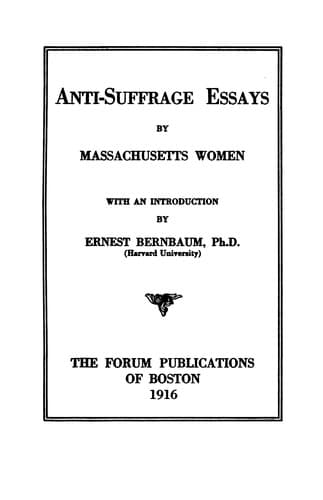
Women -- Massachusetts; Women -- Suffrage -- United States; Women's Anti-Suffrage Association of Massachusetts
For at least two generations suffragists have been spending a huge
amount of energy and money in spreading their doctrine. Contributions,
mainly drawn from a few rich women, have enabled them to send
professional speakers into every district of the state, to distribute
tons of "literature," to supply the press with a constant stream of
"news" written from their point of view, and in general to advertise
their claims in the most lavish way. A propaganda so subsidized would
have been successful decades ago if sound principles and common sense
were on its side. But to their consternation the suffragists found that
the vast majority of Massachusetts women turned a deaf ear to their
plausible appeals, and that their strongest opponents were those of
their own sex.
Suffragists continued to talk about what "we women" want. But men
presently began to see that these women had no right to pretend to
represent their sex. Even their own claims as to the number of women
supporting them showed that they represented only between 5% and 10% of
the women of Massachusetts. At least 90% of the women--either by open
opposition, or by a marked indifference to the subject--showed that they
did not believe in woman suffrage. It became obvious that no general
statement could be more emphatically true than that Massachusetts women
did not want to vote.
When this truth was insistently pressed upon the suffragists, they were
apt to call the indifferent women "unenlightened." This was felt to be
an insult rather than an explanation. The average Massachusetts man does
not think his mother, wife, and sister "unenlightened"--certainly not on
the suffrage question. She has heard and read the suffrage notions again
and again. He knows that if she felt that man was her oppressor, or that
the welfare of herself or her family would be increased by her
enfranchisement, she would say so. She is a sensible, observant woman,
who knows what she wants, does not hesitate to ask for it, and usually
gets it. But she was not asking for the ballot. It did not take her long
to see through the suffrage fallacy that "only those women would need to
vote who want to." She realized that the vote would mean an obligation
as well as a privilege, and that she could not honorably accept the
privilege without undertaking the obligation. Her life being already
crowded with duties that only she could discharge, she would not add to
them one that her husband, brother, or son can discharge at least as
well.
Public-domain text, read in full here on John Shaqi.
Reviews
Reviews
No reviews yet
Be the first to share your thoughts on this work.
Join the Discussion
Join the discussion
Sign in to leave a comment or review.
Sign InorCreate an account