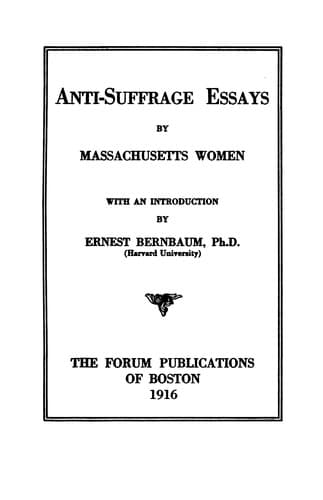
Women -- Massachusetts; Women -- Suffrage -- United States; Women's Anti-Suffrage Association of Massachusetts
If any man wondered whether his personal inquiries among the women of
his acquaintance gave a sufficiently broad basis for the belief that
women did not want to vote, he became convinced of the fact when he
learned about the Drury bill of 1913. This bill would have given
Massachusetts women a chance to vote "Yes" or "No" on woman suffrage.
The proposal resulted in the amazing revelation that the suffragists
were afraid to let women vote on the question. They worked against the
bill because they knew that an official count would disclose how
pitiably small a fraction of women were on their side. They thought that
their little group, by noisy publicity, could be made to appear a
considerable number. But the men, when they discovered who opposed the
Drury bill, were not deceived. They saw that a small minority of women
was trying to induce them to coerce the great majority. They awoke to
the fact that the suffragist's demand was not that men should grant
women an expressed desire, but that men, contemptuously disregarding the
evident wishes of women, should force upon them a heavy responsibility.
The nature of that responsibility brings us to what seems to me the
second important cause for the suffrage defeat. Men--more than
politically inexperienced women,--know that good government depends upon
the willingness of the electorate to do its duty vigilantly and
regularly. The greatest good of the greatest number of classes
(including the women and children in each class) can be secured only
when a large proportion of the eligible voters vote. Those voters who
are led by bosses, or by selfish interests, go to the polls steadily.
Their influence can be offset only when the rest of the electorate goes
likewise. The results of elections in which a small proportion of the
eligible voters take part, are poor laws and incompetent or corrupt
government. The leading political issues--the tariff, trusts,
transportation, military and police force, taxation, finance, etc.--bear
directly upon the work of men in their trades and business, and under
male suffrage a fairly large proportion of the vote is cast. The
life-work of women removes them from contact with these political
questions, and the nature of most women is not attracted by the
contentious spirit in which political warfare is conducted. As long as
no more than 10% of the women took an interest in the woman suffrage
question itself, no man could reasonably expect them to be otherwise
than indifferent to the regular subjects of political conflict. To
impose political duties upon the sex against its will was simply to
create conditions that encouraged corrupt and feeble government. The
soundness of this principle was, furthermore, being demonstrated in
woman-suffrage territory, such cities as Seattle and such states as
Colorado showing that sooner or later a neglectful electorate leads to
the downfall of good government.
Public-domain text, read in full here on John Shaqi.
Reviews
Reviews
No reviews yet
Be the first to share your thoughts on this work.
Join the Discussion
Join the discussion
Sign in to leave a comment or review.
Sign InorCreate an account