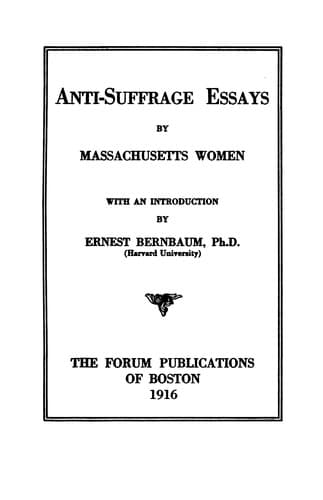
Women -- Massachusetts; Women -- Suffrage -- United States; Women's Anti-Suffrage Association of Massachusetts
_Miss Catherine Robinson was a student at Radcliffe in 1911;
graduated from Miss Wheelock's Kindergarten Training School in
1915; has worked two winters among the children in the cotton
mills of Georgia, and has been affiliated with Neighborhood
House in East Boston, and with the Associated Charities in the
Co-operative Workrooms. She is now connected with the Social
Service Department of the Massachusetts General Hospital, her work
being in the Orthopaedic Clinic for Children. Miss Robinson was
formerly a suffragist, but after studying the question decided
that the suffragists' claims are illusions which never become
realities. She says: "Everything I do along these lines (Social
Service) convinces me more than ever what a detriment the vote
would be to our sex."_
_J. A. H._
Not long ago I heard Dr. Anna Howard Shaw, the President of the National
Woman Suffrage Association, say at Springfield:
"Laws have nothing to do with this question of woman suffrage; facts
have nothing to do with it. I shall not answer facts. We do not promise
to do great things for women; why should we? All we ask is the right to
vote."
All suffrage speakers are not so frank about their inability to answer
facts as Dr. Shaw is, nor do they cease from claiming that good laws for
women exist chiefly in suffrage states.
Massachusetts gives to her women the best protection of any state in the
Union. In January, 1915, New York ranked first, but since our
legislative enactments of 1915, Massachusetts is again in the lead. We
have, in the first place, the Maternity Act. Then we have the law
prohibiting women in industry from working more than fifty-four hours
per week. We have the absolute prohibition of night-work for our women
in textile, mercantile, and manufacturing establishments. We are one of
the five states in the Union to have such a law. All the five states are
male suffrage states. Not a single woman suffrage state prohibits the
night employment of its women; and yet among the laws safeguarding the
health of women workers, the prohibition of night work is of the most
fundamental importance.
Public-domain text, read in full here on John Shaqi.
Reviews
Reviews
No reviews yet
Be the first to share your thoughts on this work.
Join the Discussion
Join the discussion
Sign in to leave a comment or review.
Sign InorCreate an account