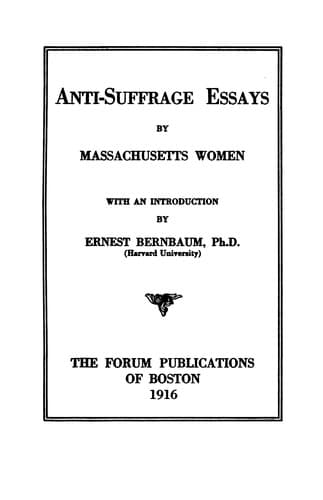
Women -- Massachusetts; Women -- Suffrage -- United States; Women's Anti-Suffrage Association of Massachusetts
Some women suffrage states do not even set a limit to the hours a woman
may work. In Wyoming, Nevada, and Kansas--all woman suffrage states, you
note--there is no limitation of hours of labor and no prohibition of
night work. Some one may say that Colorado, California, Oregon and
Washington have an eight-hour limitation. They have; but in each case
the canneries are excepted, so that in those states where the cannery
business is of vast importance, the women therein employed may work any
number of hours and any time of the day or night. Not long ago in New
York a similar law was proposed, allowing women and children to work
seventy-two hours a week in canneries, but the bill was defeated.
Colorado, to be sure, has the eight-hour law, but it does not prohibit
night work for women, so that the eight hours can be at night; neither
does Colorado require one day of rest in every seven. In Massachusetts
and New York there is a law specifically requiring one day of rest in
every seven for employees in factories, workshops, and all mercantile
establishments.
Another way in which we can protect women is by early closing hours, and
prohibition of work before a certain hour in the morning. Again we find
that it is in the male suffrage states that women have acquired such
protection, for New York sets an early closing hour of 5 p. m. for her
women in factories, mercantile, and manufacturing establishments, and
Massachusetts sets 6 p. m. Fourteen other male suffrage states set 10
p. m. as the closing hour; and all these states prohibit work before 6
a. m. What do we find in the woman suffrage states? Simply that out of
the eleven suffrage states, one state, California, sets a 10 p. m.
limit, but it does not apply to canneries.
As women enter further into the industrial field, more and more laws are
made for their protection. The men have done wonderfully for our women.
Whenever the public conscience is aroused to the need of a law, that
law is passed. Women do much, in fact, nearly everything, towards
arousing that public conscience, but we find when we study the laws as
they exist in our state that our men have made better laws for the
protection of our women than the men and women have made together in any
suffrage state. Let me add some of the other good laws we have in
Massachusetts. We have the Mothers' Pension Bill. This law was
originated by a man in a male suffrage state. We have the Equal
Guardianship Law. There are suffrage states where neither of these laws
exist.
Public-domain text, read in full here on John Shaqi.
Reviews
Reviews
No reviews yet
Be the first to share your thoughts on this work.
Join the Discussion
Join the discussion
Sign in to leave a comment or review.
Sign InorCreate an account